Friday, February 14, 2014

A Galway Love Story

If this particular time of year makes one appreciate a good love story all the more, then the story of James Joyce, Nora Barnacle, the death of a young man and a mix of poetry and the greatest short-story ever written surely makes this a suitable and timely tale.

Moving from Galway city and areas such as Rahoon to Dublin City on the feast of the Epiphany, the story of love and loss is retold through a blurring of reality and fiction. Manuscripts here at the Hardiman Library add much to the telling of the story.

Among the Special Collections is a limited edition manuscript copy of Pomes Penyeach, a book of poems hand-written by James Joyce, printed on Japanese silk paper and hand illustrated by Joyce's daughter, Lucia Joyce. Published by Obelisk Press and sent to the Hardiman Library directly by James Joyce in 1935. Obelisk press was run by Run by Jack Kahane, an admirer of Joyce’s work, and Desmond Harmsworth.


Editions were signed by Joyce and offered for sale at £12. Joyce sent copies to other authors and connections in the publishing world. His letter to the Librarian at University College Galway notes that copies were also deposited in the British Museum Library and the Bibliothèque Nationale in Paris, France.

Inscription by James Joyce

Joyce’s letter to Prof. John Howley, University Librarian of U.C.G., was written in August 1935 and in it he indicates that his uncle-in-law, Michael Healy, had requested him to send a copy of the special edition of Pomes Penyeach to the Library. Joyce states that he was doing so not only because the illustrator was a “grand-daughter of Galway” and the bearer of one of the ancient tribal names but also as a token of appreciation of the support he had received over the years from Michael Healy himself.

Letter from Joyce to UCG Librarian, 1935

The story takes a twist when one looks at the poem, 'She Weeps Over Rahoon'. The wall of the graveyard in Rahoon now bears a plaque bearing an inscription of the poem. The graveyard also holds the family vault of the Bodkin Family of Galway and in it lies the remains of 17 year-old Michael Bodkin, who prior to his early and untimely death was the boyfriend of the young Nora Barnacle. Nora, of course would later be the love of James Joyce.

Example of illustration in 'Pomes Peanyeach'
'She Weeps Over Rahoon' - Rahoon Graveyard


In 'The Dead', Joyce's masterpiece finale to his volume of short-stories, Dubliners, the character of Gretta Conroy mourns still the death of her young lover, also named Michael, and who died many years previously in Galway. In a powerful climactic scene of the film version of 'The Dead', directed by John Huston, Gretta (played by Anjelica Huston) tells for the first time to Gabriel (Donal McCann) of her past love for Michael Furey:

"O, I am thinking about that song, 'The Lass of Aughrim'. . . I am thinking about a person who used to sing that song . . . I think he died for me."


'The Dead' - from the Huston Archive
Script cover page - 'The Dead' - from Huston Archive

Scene of revealing of past love for Michael Furey - 'The Dead'
From the Huston Archive


Scholars have debated that this Michael Furey is indeed the same Michael Bodkin who was in love with and loved by Nora Barnacle and whom Joyce had written into the story "The Dead". What is for certain is that this is truly a gripping and masterful story, a love story of reality and fiction.

The Huston archive online exhibition is available here

For more on the Archive and Special Collections of the Hardiman Library please click here.

Thursday, February 13, 2014

Stephen Gwynn and University College Galway


On this day, 13 February 1864, Stephen Lucius Gwynn, writer, politician and soldier was born as Saint Columba’s College, Rathfarnham, Dublin, eldest son of John Gwynn, warden of St. Columba’s and later professor of divinity at TCD, and Lucy Josephine, daughter of  William Smith O’Brien. Having worked as a teacher and writer for a number of years, he returned to Dublin and in 1906 won the by-election for Galway City for the Home Rule Party under John Redmond against John Shaw-Taylor, holding the seat until 1918.


In this letter to Professor Senier, Mr Gwynn is arranging to meet ahead of a deputation to the Chancellor of the Exchequer in London in relation to University College Galway. Professor Senier was born in Lancashire and studied under A W von Hofmann in Berlin. He became Professor of Chemistry at QCG in 1891 and established a reputation as a prominent academic in his field. He died on 29 June 1918 and is buried in the new cemetery, Bohermore, Galway.  Another member of the deputation was Sir Peter Freyer, a graduate of QCG who had been in the Indian Medical Corp and by 1910 was consulting surgeon at the Queen Alexander Hospital and Millbank in London. He pioneered an operation now known as a prostatectomy.  The letters relating to the deputation are part of one of our small collections (P32), more information on the interaction between the University and the London Government are available in the Papers of Professor Alfred Senier (A21), and the archives service also holds the papers of Sir Peter Freyer (P57), the descriptive list for this collection is online at http://archives.library.nuigalway.ie/cgi-bin/tabbedlist.cgi?P57

Wednesday, February 12, 2014

Sigerson Cup - Looking back to 1912

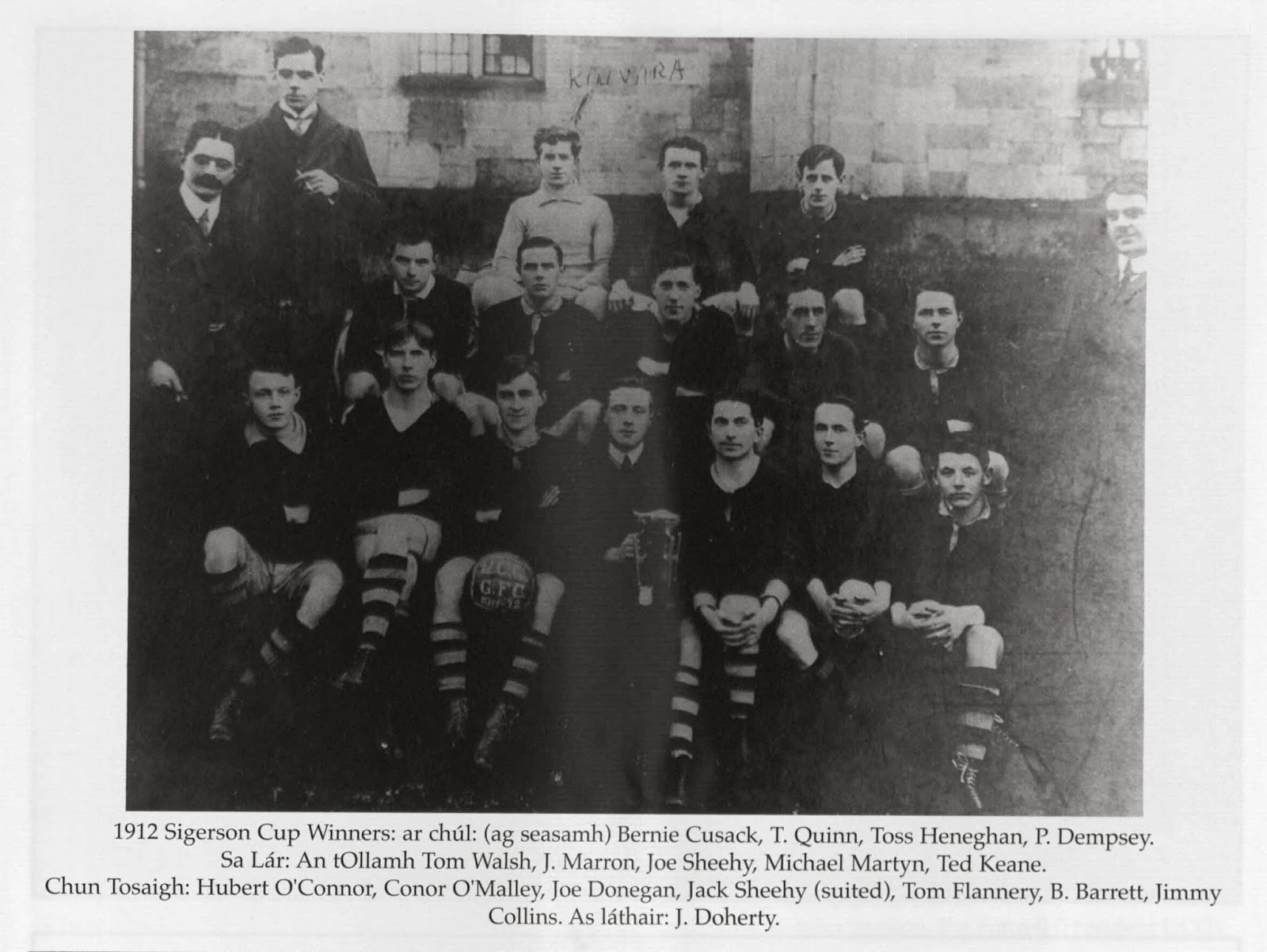
The colleges competitions of the Sigerson football and FitzGibbon hurling cups are in full swing at the moment it is a timely chance to look back at NUI Galway (or University College Galway as it then was) and its first win in the competition in 1912. First contested in 1911, UCG won the second year of the competition in 1912 where Joseph F. Donegan was Captain of the winning UCG team which defeated University College Cork on a scoreline of 1-4 to 1 point.

The victorious U.C.G. team are pictured here:


University College Galway also went on to claim the Sigerson 50 years later 1962 with the winning team pictured here:


The Sigerson and FitzGibbon cups are two of the GAA oldest competitions and with such a rich history and tradition. Best of luck to all!


Tuesday, February 11, 2014

"The Plough and the Stars" and its Critics

On this day, 11th February 1926, rioting greets the Abbey Theatre performance of Sean O'Casey's "The Plough and the Stars" because of what was viewed as it's anti-Irish sentiment. Yeats tells the audience "You have disgraced yourselves again".

From the Shields Family Collection is a photograph from that production, featuring G Fallon, Arthur Shields, FJ McCormack and Shelah Richards(T13/B/246). In spite of the controversy surrounding aspects of the play, it played to full houses, and had many re-runs and revivals, as well as a film version in 1937.


In a reply to critics, printed in "The Irish Times" on 19 February 1926, O'Casey tackled some of the criticisms of the play, and went on to state.
The politicians - Free State and Republican - have the platform to express themselves, and Heavens knows they seem to take full advantage of it. The drama is my place for self-expression, and I claim the liberty in drama that they enjoy on the platform (and how they do enjoy it!), and am prepared to fight for it.
For more on productions of "The Plough and the Stars" check out the Shields Family Collection at http://archives.library.nuigalway.ie/cgi-bin/FramedList.cgi?T13 and programmes from the various Abbey Theatre productions are available to third level researchers in our Archives and Special Collections Reading Room under the Abbey Theatre Digitization Project.

Monday, January 27, 2014

CFP: Pushing Form - Innovation and Interconnection in Contemporary European Performance

European and Western performance discourse historically has often presumed a hegemonic and majority white field of practice despite an increasingly diverse European population. How does the present reality of European theatre and performance challenge traditional assumptions? And how specifically does formal innovation provide the space for critiques of power and hierarchy that may rework the concept of “Europe” as realized through performance? How have artists responded through form to neoliberalism and globalization in the wake of the most recent world economic crisis and how does their specifically European context set the terms of this response?

The spread of Live Art has put pressure on the institutional theatre as the primary cultural site for performance in many European nations. Yet, discussions about the usefulness and limits of postdramatic as an umbrella term for interdisciplinary work that resists overdetermining dramatic literature might seem to characterize this moment in European theatre and performance studies. This conference queries what it means to define the field of European performance. As such, we invite submissions that will consider key debates in terminology surrounding innovative emerging work, seeking also to build on older genealogies of practice in Europe and beyond. For the purposes of this conference, we will use “European performance” to designate work that happens within the continent as opposed to the European Union exclusively, although these differential power dynamics will be crucial to our inquiry.

Meanwhile, experimental performance methodologies including devising, site-specific approaches, performance art and new media are increasingly taught within universities, signaling an integration of knowledge that may confirm the field of the “contemporary” through institutional status, but suggests that these practices may no longer be the cutting edge. By considering macro-European trends in relationship to national case studies, “Pushing Form” will explore the meaning of “contemporary,” “European” and “performance” in relationship to each other. We hope to map not only the current field, but what may lie just beyond it.

For further information, please contact any of the conference organizers:
Dr Charlotte McIvor, NUI, Galway: charlotte.mcivor@nuigalway.ie Phone: 00 353 91 492631 
Dr Siobhán O'Gorman, Trinity College Dublin: siobhanmogorman@gmail.com
Dr Miriam Haughton, University of Ulster: miriamhaughton@hotmail.com


'Pushing Form' is sponsored by the Millennium Fund and NUI Galway Drama and English.

Book of the Month - Dictionary of Greek and Roman Biography and Mythology (London, 1849).

The start of the new term brings the return of our Book of the Month from the Special Collections Library here at the Hardiman Building. Each month these treasures and gems from our collections will be on display in the Special Collections Reading Room in the Hardiman Research Building.


This month (and catch it while you can!) is Dictionary of Greek and Roman Biography and Mythology (London, 1849). This beautifully bound three volume set was awarded to Richard Blair Bagley by Queen’s College Cork in the 1850s for a First in French. R.B. Bagley (d. 1869) went on to became Professor of Latin at Queen’s College Galway in 1854. 

Taking the dates and context of these volumes throws up an extraordinary link through time. They match by way of year of publication with the year of the opening of Queen's College Galway. (1849) It is fascinating to think that today, in our newly opened reading room, are these books awarded to one of our first professors and dating back to the year of their publication coinciding with the first students arriving here on campus and also exactly 160 years ago this year Bagley was appointed Professor of Latin.


Bookplate awarding the volumes to Bagley

If you would like to view/ consult this item, please submit an online request or contact the staff of the Special Collections Reading Room in the Hardiman Research Building at specialcollections@nuigalway.ie.

Wednesday, January 15, 2014

New Stages: Theatre Tours to the Prisons

Earlier this week, as the Abbey Theatre look back in detail on Dublin life in 1913 at the height of the Strike and Lock-Out through the words and drama of James Plunkett's The Risen People, the play found a new audience in the prisoners and staff of Wheatfield Prison.  In terms of Irish touring theatre this is an unusual but not quite a unique departure.

As reported in TheIrish Times earlier this week:

The Great Dublin Lock-out became temporarily locked-in last night when, on an occasion that was historic in more ways than one, the Abbey Theatre presented its latest production behind bars.
The Risen People, a musical adaptation of James Plunkett’s play about the events of 1913, was transferred for an evening to Wheatfield Prison, where it was watched by 200 inmates, staff and invited guests.
The set was scaled down to fit the stage of the Wheatfield assembly hall, otherwise, this was the full Abbey experience, available in an Irish prison for the first time in its 110-year existence.

Though a first for the Abbey and yet another landmark in the story of its rich 110-year history, It was back in 1987 that Druid Theatre also crossed the gates and performed in Irish prisons. As part of their nationwide 1987 tour of Tom Murphy's Conversations on a Homecoming, the play was staged in Cork, Mountjoy and Arbour Hill prisons.

Within the Druid Archive here at the Hardiman Library, NUI Galway, is a letter of feedback from an unnamed prisoner within Arbour Hill. Entitled "Thank you for an evening's entertainment", the inmate wrote in detail a review and experience of the production in Arbour Hill. Comments include:

"Firstly, I would like to say a big thank you to one and all connected with the bringing this play to the prisons. . . We, the inmates or prisoners if you prefer, appreciated what must have been a very hard and apprehensive decision for you to make. Also, the prison staff deserve a clap on the back for making it such a wonderful evening."

The review continues: The characters by the cast were brilliantly performed.  .  .The professionalism was one of total enrapture for the audience which held our eyes constantly on every movement on stage. Any noise in the audience was met with a 'hush, hush, Silence please!' reaction from the rest of the audience."
Comments from prisoners, 1987


The letter concludes by comments from the prisoners with one being "It's nice to know that not everybody has forgotten about us in here, thanks a million to the cast of Druid Theatre Company."

This file on the 1987 Prisons tour by Druid Theatre is accessible at T2/144.

The Druid Archive catalogue can be viewed in full here

Press coverage of the 1987 prison tour (Click to enlarge)