
Tuesday, October 28, 2014
Digital Scholarship Series at the Hardiman Building - Autumn 2014 Schedule
Another edition of Digital Scholarship Series of talks and lectures is beginning this November at the Hardiman Building, NUI Galway. With sessions focusing on advances, new projects and research in the Digital Humanities from speakers locally, nationally and internationally, it promises to be a really exciting and interesting series. All information and contact details of organisers can be seen on the following poster:


Thursday, October 23, 2014
Announcing Symposium on Archives, Human Rights and Activism & Launch of Kevin Boyle Archive

The family of the late Professor Kevin Boyle, co-founder of the Irish Centre for Human Rights (ICHR), has kindly deposited the Kevin Boyle archive at the James Hardiman Library, NUI Galway. This important archive has much to say about the pursuit of human rights in Ireland, the UK and internationally. The Archive will be launched at a series of events at NUI Galway on the 28th November 2014. A day-long symposium, organised by the ICHR and the School of Law, will bring together leading human rights scholars and activists to address the theme “The Human Rights Scholar-Activist or Activist-Scholar" and will also explore issues of human rights, archives and memorialisation. The keynote speaker is Professor Sir Nigel Rodley, Chairperson of the UN Human Rights Committee.
Panel speakers include:
Brice Dickson
Michael Farrell
Tom Hadden
Françoise Hampson
Barry Houlihan
Bernadette McAliskey
Marie McGonagle
Tarlach McGonagle
Donncha O’Connell
Pól O’Dochartaigh
Michael O’Flaherty
Louis Boyle
28 November 2014
All are welcome.
Following the Symposium, the Archive of the late Professor Boyle, catalogued and available at the Hardiman Library at NUI Galway, will be officially launched by Máire Whelan, S.C., Attorney General.
For further information: humanrights@nuigalway.ie
To register for Symposium: www.conference.ie
Tuesday, October 21, 2014
The Will of James Hardiman
James
Hardiman, historian and librarian was born around 1782. Hardiman was born in
Westport, County Mayo, in the west of Ireland around 1782. His father owned a
small estate in County Mayo. He was trained as a lawyer and became
sub-commissioner of public records in Dublin Castle. He was an active member of
the Royal Irish Academy, and collected and rescued many examples of Irish
traditional music. In 1855, shortly after its foundation, Hardiman became
librarian of Queen's College, Galway. The university library was later named in
his honour.
From
Errew near Westport, the site of Errew Franciscan Monastery was donated by
James Hardiman, the foundation stone was laid on the 21st of July, 1840 and a
great number of people were present. Dr. McHale, Archbishop of Tuam was the
leader of the ceremonies. James Hardiman laid the foundation stone and placed
coins of the day under it, the people of Errew helped with the building. Local
tradition in Errew states that James Hardiman had a son called
`Black James Hardiman`. `Black` James often visited the Monastery and had
special rooms reserved for him there. He married a lady from Galway and lived
in Dublin. When his wife died he left Dublin and it is believed that he had no
family and his whereabouts were unknown.
 |
| James Hardiman, Historian and first Librarian of Queen's College Galway |
This
will of James Hardiman who died in 1909 fills in the details of this Black
James Hardiman. Two beneficiaries are mentioned in the will Lily O’Flaherty
Johnston of Kilmurvey House, Aran Island and Brigid (or Delia) O’Flaherty of 51
Leinster Road, Rathmines, Dublin. Lily and Brigid are sisters, and another
sister, Julia, had married James. The O’Flaherties were middlemen who became
the biggest landholders on Inis Mór, and feature strongly in Tim’s book Stones of Aran: Labyrinth. Because of
this will we have an address for James in Dublin, and from the Census returns
of 1901 held in the National Archives of Ireland and now available digitally,
James’ age is given as 81 in 1901, and Delia’s as 45.
This
will and it’s associated material relating to James Hardiman’s grave plot in
Glasnevin, was donated by Tim and Mairéad Robinson as part of their collection to John Cox, the
librarian of the James Hardiman Library in September 2013. It is a link between
the many strands that go to make up Humanities research. From the work of James
Hardiman himself, to the folklore of his local area of Errew, available at http://www.castlebar.ie/clubs/ballyheane/bally2.html.
Black James Hardiman features in the work of Tim Robinson in a footnote, that
has contributed to an entry by Moore Institute scholar Deirdre Ní Chonghaile,
who’s blog entry on the piano at Kilmurvey House available at http://aransongs.blogspot.ie/2013_12_01_archive.html
fills in the O’Flaherty of Aran connection with James Hardiman. The address
furnished in the will allows us to check the census returns in the online
version of the 1901 census digitized by the National Archives of Ireland
available at http://census.nationalarchives.ie/pages/1901/Dublin/Rathmines/Leinster_Road__Part_/1296656/
.
This
will provides a tangible link with the family of the first librarian of this
Library, and is an example of how one item can link and overlap with other
research being done in the humanities.
Wednesday, October 1, 2014
New exhibition on Irish and Russian Theatre coming to Hardiman Library

A new co-exhibition, “Unchanged but the Spirit. . . ’, launching 7 October 2014, between the James Hardiman Library, NUI Galway the Russian State Art Library, Moscow, will for the first time in Ireland, present archive material on the production and stage history of The Seagull by Anton Chekhov, from initial staging in 19th Century Russia to later adaptations in contemporary Ireland.
The Chekhovian classic The Seagull has engaged and provoked audiences since its Moscow premieré in 1896. From a poor initial reception from audiences and critics alike, the play was close to being abandoned and forgotten until it received its production at the Moscow Art Theatre, directed by Constantine Stanislavsky in 1898. Since then, the play has been regarded as one of Chekhov’s finest works. In an Irish context, the play received a translation and adaptation by playwright Thomas Kilroy, premiering at the Royal Court Theatre, London in 1981. In opening up and combining the archive sources of Kilroy and other theatre archives of the Hardiman Library and of the R.S.A.L collections in Moscow, the exhibition will highlight how across cultures, languages, societies and centuries, theatre and its impact can remain unchanged.
This exhibition will simultaneously stage material from the theatre collections of the Hardiman Library and the Russian State Art Library in both Galway and Moscow throughout the month of October and is a unique chance to see a visual and archival history of The Seagull, in its many manifestations, from Chekhov to Kilroy.
All are welcome to attend the launch of the exhibition by Dr. Ian Walsh, Centre for Drama, Theatre and Performance, NUI Galway, at the Hardiman Building (Room G011) at 6pm, Tuesday, 7 October.

Friday, September 19, 2014
Announcing: 'Interpreting Landscape': Symposium on Tim Robinson
 |
| Tim Robinson |
Interpreting
Landscape
Moore Institute International Symposium
Tuesday 30 September 2014
Hardiman Research Building, National University of Ireland, Galway
Booking essential: http://www.nuigalway.ie/mooreinstitute
Schedule:
10.30 Registration and coffee/tea. Venue: entrance to Room
G010, Atrium of the Hardiman Research Building
11.00 Welcome by Daniel Carey, Director of the Moore
Institute. Venue: Room G010
11.05 John Wylie, Exeter University: So near and yet so
far'.
Discussion
11.50 Justin Carville, Dun Laoghaire Institute of Art and
Design: 'Lines of sight and historical topographies: photography, anthropology
and archaeology in the West of Ireland'
12.30 Nicolas Fève, photographer: introduction to his
photographic practice and interpretation of landscapes evoked by Tim Robinson,
followed by Justin and Nicolas in conversation, and discussion
13.00 Lunch break and opportunity to visit the exhibition ‘Interpreting
Landscape: Tim Robinson and the West of Ireland' / ‘Rianú Talún: Tim Robinson
agus Iarthar na hÉireann', in the Atrium, Hardiman Research Building. This
exhibition displays elements of the Robinson Archive in the James Hardiman
Library, together with photographs by Nicolas Fève and extracts from John
Elder, Nicolas Fève and Tim Robinson, Connemara and Elsewhere (Royal Irish
Academy, 2014). A display of other archives relating to landscape can be viewed
in the nearby Special Collections Reading Room.
13.45 Nessa Cronin, National University of Ireland, Galway:
‘Interpreting island space: gender, science, and empire in the life and work of
Maude Jane Delap (Valentia Island, 1866-1953)'
Discussion
14.25 John Elder, Middlebury College, Vermont: 'Dwelling on
the edge'
Discussion
15.15 Short break
15.30 Screening of ‘Unfolding the landscape', a filmed
interview with Vincent Woods, Tim Robinson and Nicolas Fève. Venue: Seminar
Room G011, Hardiman Research Building
16.30 Close of symposium
Please click on the link below to register for this event
Monday, September 15, 2014
Join Us For Culture Night 2014 at the Hardiman Library!

The annual wave of all things culture is ready to pour over Galway City and County (as well as all of Ireland!) as Culture Night 2014 arrives on 19th September. The Hardiman Library is delighted to be staging a series of events that celebrates the richness of its Archive collections. From 6pm all are welcome to join us for a special evening of film, talks and tours that covers over 500 years of local and national history as well as opens up the story of how Galway and Hollywood came together and is recorded in the archive of the Oscar-winning director John Huston, whose vast film archive is held by the Hardiman Library.
Commissioned by John Huston in 1958 to prepare a scenario for a film on Sigmund Freud, Jean Paul Sartre, the French philosopher, actually wrote two scenarios - the first before visiting Huston at St Clerans, County Galway in autumn 1959, and the other afterwards. Both were far too long, but after much pruning and rewriting Freud: The Secret Passion premiered in 1962.
This illustrated talk by Prof. James Gosling will explore the script of The Secret Passion, contained within the Huston Family Archive at the James Hardiman Library, written by Sartre, edited by Huston and then later rejected by Sartre. Prof. Gosling will share his extensive archive research on the script held at the Hardiman Library and also on the other various versions held in Paris. The findings will prove to be an entertaining and enlightening evening showcasing one of Galway's great cinematic histories.
There will be a special showcase of archival material from the Huston Family Archive.
Time: 6pm
Venue: Moore Institute Seminar Room, Hardiman Research Building, NUI Galway
Contact: barry.houlihan@nuigalway.ie
Tuesday, August 26, 2014
Land - Ownership, Occupancy & Use: the O'Connor Donelan Archive
 |
| Letter from John O'Connor Donelan to his mother 21 July 1893 |
Land–its ownership, occupancy and use– has been a central motif in Irish history and in the Irish imagination for centuries. Land has been a source of wealth and income, as well as a key marker of social rank and political power. A history marked by confiscation and plantation resulted in the land being a site for conflicting claims and identities in Ireland. Accordingly, primary documentary records relating to Irish landed families and estates provide a rich resource for the investigation of many aspects of Irish history.
The Archives of the Hardiman Library hold a number of landed estate collections relating to major estates and families in the West of Ireland. The O’Connor Donelan collection provides a good example of the value of such records. The papers relate to the O'Connor Donelan family of Sylane, Tuam, County Galway. The papers cover the legal dealings of the family, the management of their various lands, and personal papers relating to various family members. The bulk of the personal material relates to Thomas O'Connor Donelan (1812-1874) and his sons. His eldest son Dermot had an interest in genealogy and forestry, and his other three sons were doctors in Dublin, Leeds and Manila.
 |
| Thomas O'Connor Donelan, c. 3 years old, c. 1870 |
A Galway landowning family, the O’Connor Donelan family papers relate principally to the nineteenth century, though reflecting the activities of both the Donelan and O’Connor families in earlier centuries. The papers document various aspects of the lives and range of interest and responsibilities of the family: the legal aspects of their affairs, the challenges of estate management and the personal concerns (including political activities) and contacts of family members in the nineteenth century. The collection offers the researcher a valuable case-study of a modest Galway landed estate of the nineteenth century.
Also available online from NUI Galway is the Landed Estates web site, www.landedestates.ie, a comprehensive and integrated online resource guide to landed estates and gentry houses in Connacht c.1700-1914.
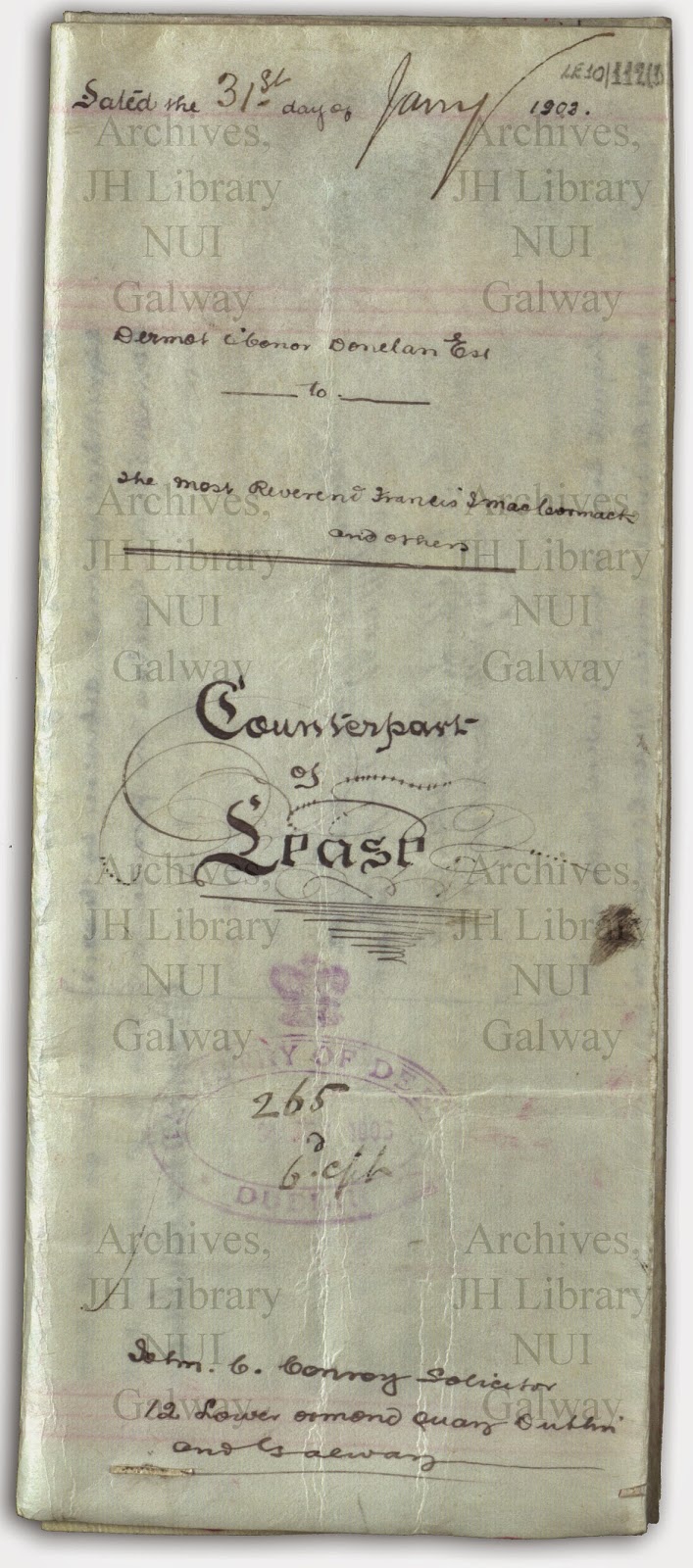 |
| Lease for Cuilmore [Peterswell, County Galway]., containing three acres, for use as a priest's residence for 999 years, at £11 per annum. 31 January 1846 |
Subscribe to:
Posts (Atom)
