Tuesday, October 29, 2024

Treasures of the O’Gorman Special Collection Blog Series - William Butler Yeats


Treasures of the O’Gorman Special Collection Blog Series

William Butler Yeats  

A literary collection owned by the late entrepreneur, local historian and supporter of the arts, Ronnie O’Gorman, was recently donated to the University of Galway. This collection, spanning three generations of the O’Gorman family, includes countless items of literary and historic value.

Poems 1899-1905

To read more about this donation, please see: O’Gorman Collection donated to the University of Galway. 

In this new blog series, we will highlight some of the treasures of this extensive and carefully curated collection. This first blog post will highlight some of the unique and rare volumes by William Butler Yeats. 
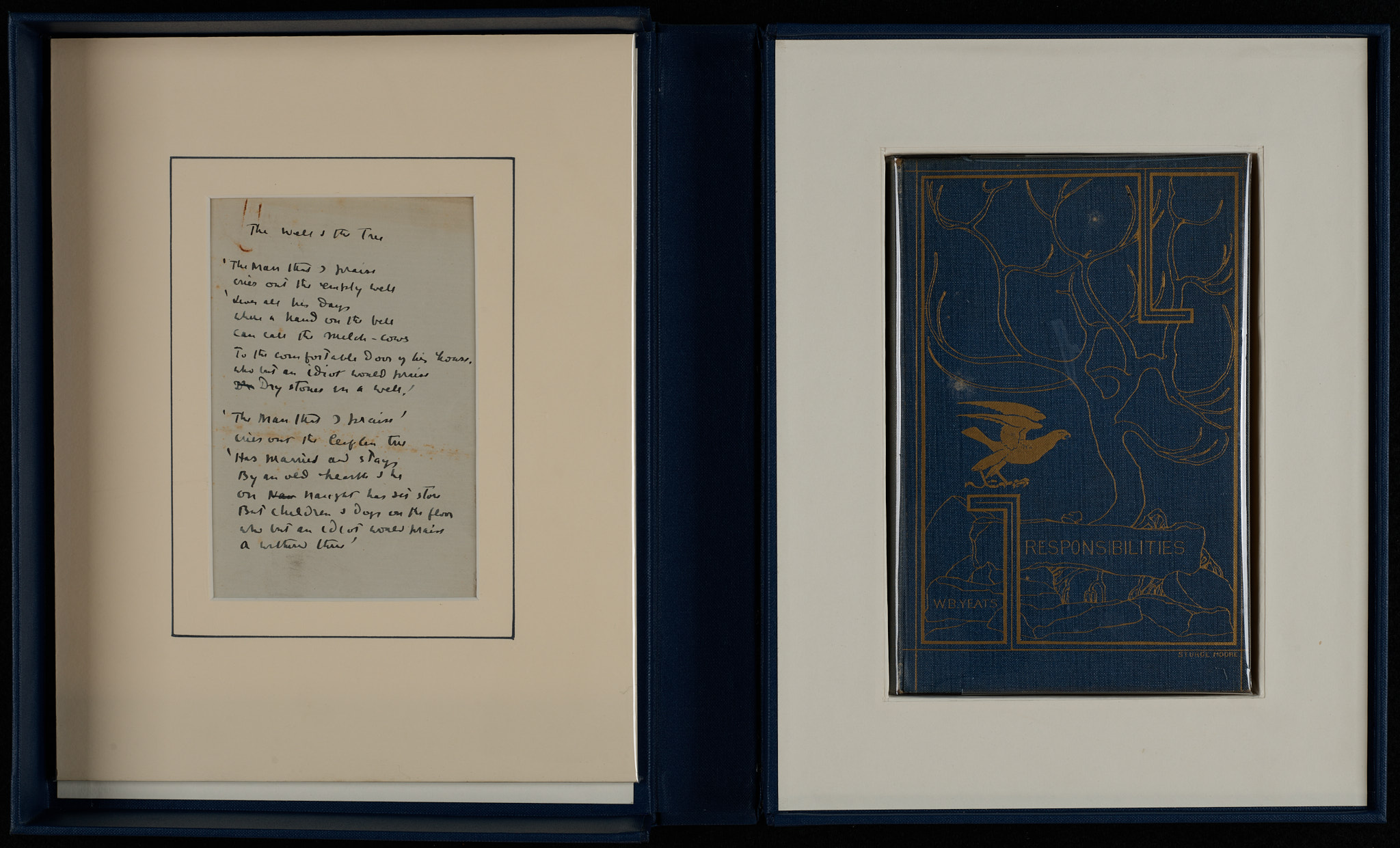
 

The Well and the Tree, manuscript copy, and Responsibilities and other poems

The Well and the Tree 

Poem by W.B. Yeats, manuscript copy 

Handwritten manuscript of Yeats’s poem “The Well and the Tree”. Held in collector's box containing manuscript as well as a volume of Responsibilities and Other Poems” by W.B. Yeats. Volume of poetry and box decorated with blue cloth cover decorated with gilt detailing. Published in 1916. 


The Well and the Tree, manuscript copy

Visions and Beliefs in the West of Ireland 

By Lady Gregory, featuring handwritten note by W.B. Yeats 

These volumes contain local folklore and legends from the west of Ireland, as collected by Lady Gregory and W.B. Yeats. Volume one is inscribed by W.B. Yeats with the following : "For wisdom is a butterfly and not a gloomy bird of prey / WB Yeats, May 16 1920."  

Volume one and two of visions and beliefs in the West of Ireland is available in this collection. Published in 1920. 


Visions and Beliefs in the West of Ireland


Poems 1899-1905 

First edition volume of poetry by W.B. Yeats 

This first edition of Poems 1899-1905 was published in 1906Added to title page is a hand written note card by W. B. Yeats which reads : "to find in all poor foolish things that live a day eternal beauty wandering on her way - W.B. Yeats, April, 1905." 

Published in 1906. 


Collected poems of W.B. Yeats 

Collection of poems by W. B. Yeats 

In excellent condition, this volume of poetry is signed by W. B. Yeats’ brother Jack B. Yeats and features a sketch of a barrow-man, signed and dated. 

Published in 1955. 


Collected poems of W.B. Yeats


The Celtic Twilight 

Book of Celtic and Irish folklore 

First edition volume which contained a handwritten letter written by W.B. Yeats penned at Coole Park. Volume in excellent condition. Published in 1893. 


The Trembling of the Veil 

Collection of autobiographical works by Irish poet W.B. Yeats 

This first edition of “The Trembling of the Veil” is a limited-edition copy noted as number 109 of 1000 copies. This volume is also signed by W.B. Yeats. Published in 1922. 


On Baile’s Strand 

Drama written by W.B. Yeats 

One act play by W. B. Yeats set in the great hall of King Concobar who exploits the temper of Cuchulain to fight and kill his own son. Paperback volume held in green linen grained protective case. Volume stored in green linen grained slip case with decorative binding. Published in 1907. 


On Baile’s Strand 

A prayer on going into my house 

W.B. Yeats ; with drawings by Rigby Graham. 

Booklet featuring artwork of Thoor Ballylee by Rigby Graham in accompaniment to poetry by W.B. Yeats. This booklet had a limited printing in 1973. 


To view these items and more within our collections, please visit our library search section of the website. 


Ábhair spéise ó Bhailiúchán Speisialta O’Gorman Sraith Blaganna

William Butler Yeats

Bronnadh bailiúchán liteartha Ronnie O’Gorman, a cailleadh le gairid agus ar fear gnó, staraí áitiúil agus pátrún na n-ealaíon é, ar Ollscoil na Gaillimhe le déanaí. Trí ghlúin de mhuintir O’Gorman a thiomsaigh an bailiúchán seo, agus an t-iliomad míreanna ann a bhfuil luach liteartha agus stairiúil ag baint leo.

Is féidir tuilleadh a léamh faoin mbronntanas seo ag: Bailiúchán O’Gorman bronnta ar Ollscoil na Gaillimhe.

Sa tsraith blaganna nua seo, tarraingeoimid aird ar roinnt de na nithe spéisiúla atá sa bhailiúchán cuimsitheach seo a bhfuil coimeád cúramach air. Díreofar sa chéad bhlag seo ar roinnt de na himleabhair uathúla agus neamhchoitianta le William Butler Yeats.

The Well and the Tree, lámhscríbhinn, agus Responsibilities and other poems


The Well and the Tree

Dán le W.B. Yeats, lámhscríbhinn

Cóip lámhscríofa den dán “The Well and the Tree” le Yeats. Tá an lámhscríbhinn á coinneáil i mbosca bailitheora in éineacht le cóip de “Responsibilities and Other Poems” le W.B. Yeats. Díolaim filíochta agus bosca le clúdach éadaigh ghoirm arna mhaisiú le mionghnéithe óraithe. Foilsithe in 1916.


The Well and the Tree, lámhscríbhinn

Visions and Beliefs in the West of Ireland

Le Lady Gregory, ar a bhfuil nóta lámhscríofa ag W.B. Yeats

Béaloideas agus finscéalta áitiúla ó iarthar na hÉireann a bhailigh Lady Gregory agus W.B. Yeats atá sna himleabhair seo. Scríobh W.B. Yeats an méid seo a leanas ar Imleabhar a hAon: "For wisdom is a butterfly and not a gloomy bird of prey / WB Yeats, May 16 1920."

Tá imleabhar a haon agus a dó de Visions and Beliefs in the West of Ireland ar fáil sa bhailiúchán seo. Foilsithe in 1920.


Visions and Beliefs in the West of Ireland

Poems 1899-1905

An chéad eagrán de dhíolaim filíochta le W.B. Yeats

Foilsíodh an chéad eagrán de Poems 1899-1905 sa bhliain 1906. Tá cárta lámhscríofa ag W.B. Yeats curtha leis an leathanach teidil, agus an méid a leanas scríofa air: "to find in all poor foolish things that live a day eternal beauty wandering on her way - W.B. Yeats, April, 1905."

Foilsithe in 1906.

Poems 1899-1905 

Collected poems of W.B. Yeats

Díolaim filíochta le W.B. Yeats

Tá dea-bhail ar an mbailiúchán seo atá sínithe ag Jack B. Yeats, deartháir W.B. Yeats. Tá sceitse de “a barrow-man” air chomh maith, a bhfuil síniú agus dáta curtha leis.

Foilsithe in 1955.

Collected poems of W.B. Yeats


The Celtic Twilight

Leabhar Bhéaloideas na gCeilteach agus na hÉireann

An chéad eagrán den imleabhar seo ina bhfuarthas litir a scríobh W.B. Yeats de láimh i bPáirc na Cúile. Dea-bhail ar an imleabhar seo.

Foilsithe in 1893.

The Trembling of the Veil

Cnuasach saothar dírbheathaisnéiseach leis an bhfile Éireannach W.B. Yeats

Eagrán teoranta de “The Trembling of the Veil” is ea an chéad eagrán seo, agus nóta déanta gur cóip uimh. 109 as 1000 é. Tá an t-imleabhar seo sínithe ag W.B. Yeats chomh maith. Foilsithe in 1922.


On Baile’s Strand

Dráma le W.B. Yeats

Dráma aonghnímh le W.B. Yeats suite i halla mór Rí Chonchobair. Téann Conchobar i dtír ar theasaíocht Chú Chulainn lena spreagadh chun a mhac féin a throid agus a mharú. Imleabhar faoi chlúdach bog atá ann agus é ar coimeád i gcás cosanta lín uaine. Tá an t-imleabhar á stóráil i gcáschlúdach lín uaine le ceangal ornáideach. Foilsithe in 1907.


On Baile’s Strand 

A prayer on going into my house

W.B. Yeats ; le líníochtaí le Rigby Graham.

Leabhrán ina bhfuil líníochtaí Rigby Graham de Thúr Bhaile Uí Laoigh taobh le filíocht W.B. Yeats. Cuireadh líon teoranta cóipeanna den leabhrán seo i gcló in 1973.

Chun breathnú ar na míreanna seo agus tuilleadh atá sna bailiúcháin againn, déan cuardach ar láithreán gréasáin na leabharlainne.


Tuesday, August 20, 2024

Markus Casey - A Life of (Re)Discovery

Markus Casey posing in front of a float plane in Lough Erne, August 2002. (P164/4/12)

Perhaps no one made an impact on the field of aerial archaeology in Ireland quite like Galway’s own Markus Casey (1957 – 2008). Equally at home in the trenches of an excavation dig, behind the camera, or in the cockpit of a light aircraft soaring over the fields and coasts of Ireland, Casey helped uncover hundreds of lost and forgotten historical sites during his three-decade career. His substantial archive of archaeological research and photographs, which totals 14 archival boxes and includes over 20,000 photographs, now resides in the University of Galway Library Archives.

Casey was born into academia; his father, Timothy, was Professor of German at the then-University College Galway. It was here that Casey would complete his Bachelor of Arts in Archaeology and Classical Civilisation in 1983. By this point, he had already cycled across Germany and then onto Greece, joining the British School of Archaeology. His BA thesis on the study of promontory forts marked the beginning of a passion project that would last the rest of his life.

Copies of Markus Casey’s 1983 BA thesis completed at the then-University College Galway (P164/2/1/1, left) and the first volume (covering Ulster, Leinster, and portions of County Cork) of Casey’s series of reports on coastal promontory forts for the Heritage Council, December 2001 (P164/2/2/2, right).
In the world of archaeology, Casey is most known for his work on the coastal promontory forts of Ireland, dating back to his BA thesis and continuing for the rest of his life. In the last 1990s, Casey would complete his long-awaited MA dissertation at University College Dublin. Casey's thesis uncovered previously unknown and unidentified Irish coastal ring forts and other archaeological sites in the counties of Clare, Galway, Mayo and Sligo. He identified 111 definite examples of promontory forts, only 37 of which were known prior to his survey, plus another potential 57 sites. Displaying his offbeat sense of humour at the beginning of his MA thesis, Casey inserted a small piece of paper stating ‘ERRATUM: This slip has been inserted by mistake.’ Casey combined this new research with his original 1980s work and follow-up research to produce a set of reports on coastal promontory forts between 2001 and 2003 for the Heritage Council.


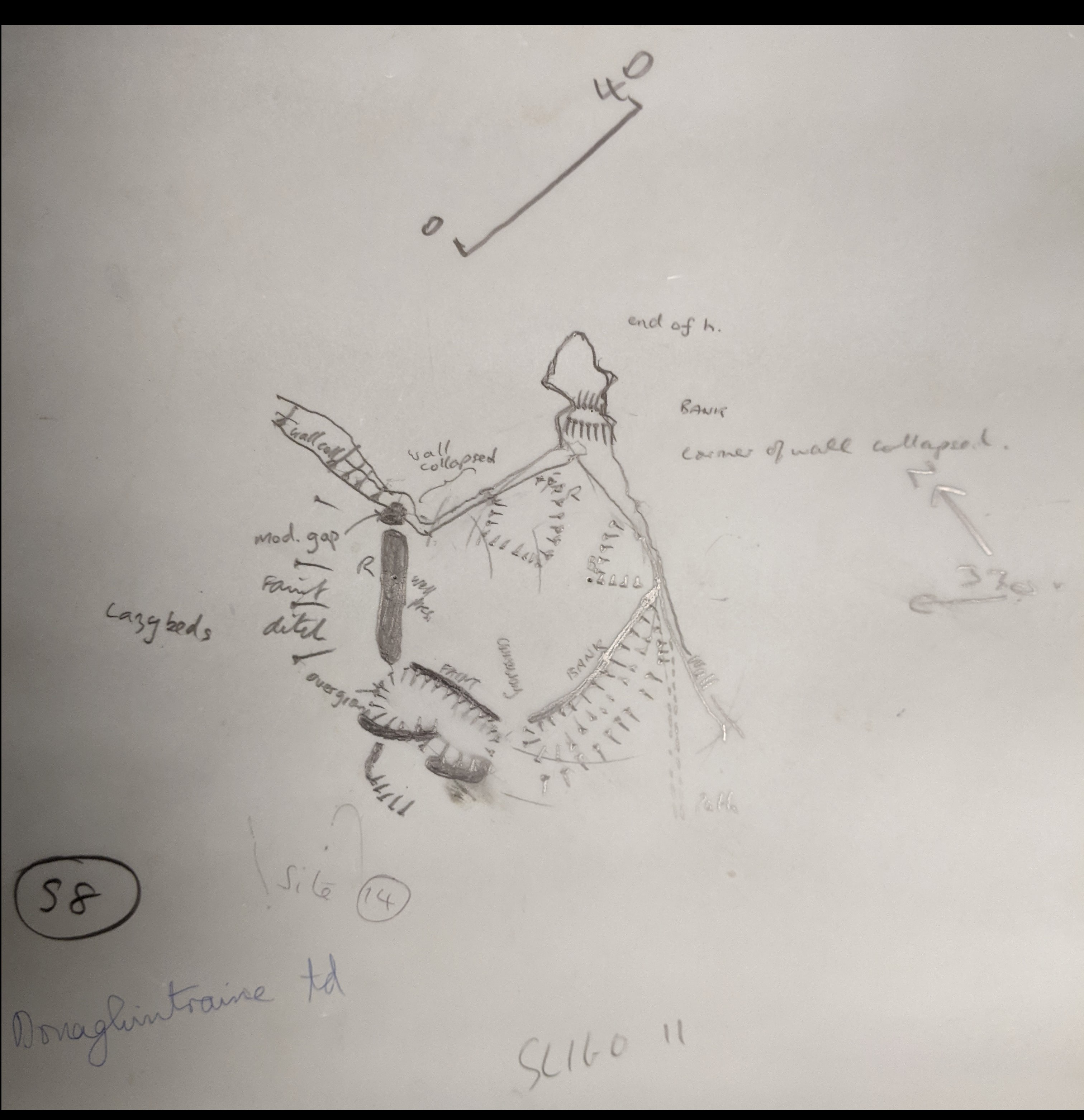
Site report and accompanying sketch by Casey of the ruins of a promontory fort at Donaghintraine, County Sligo, 8 May 1985. (P164/2/4/1/1)


Aerial view of the western tip of the Iveragh Peninsula looking toward Portmagee and Valentia Island, Kerry, 6 April 2003. The ruins of a promontory fort are barely visible on the headland at bottom, just left of centre. By 2006, Casey’s work was responsible for identifying up to 77 percent of all known promontory forts on the west coast of Ireland. (P164/4/42/2/001)


A site report on the ruins of a promontory fort at Illaunbeg (Illanebeg), Dursey Island, Cork, excerpted from the above report. Descriptions of each fort include a physical location description accompanied by one of Casey’s detailed aerial photographs. The ruins of the fort are readily visible at centre. (P164/2/2/2)


Excavations at Doonagappul promontory fort, Clare Island, Mayo, August 1992. In the days before modern computer printing, Casey pasted his photographs directly onto cardstock pages for his reports. (P164/2/2/6)


Casey’s archaeological work was not merely limited to promontory forts, as he worked extensively as an archaeological consultant on various projects. At home in Galway, Casey spent much of the late 1980s and early 1990s involved with excavations pertaining to developments in the city centre, uncovering city walls and rediscovering passageways and chambers that had been lost for centuries. During the infrastructure boom of the Celtic Tiger era, Casey’s research and survey services were in high demand as roads offices and county councils across the country sought to determine if new alignments of roadways and expanded sewer systems would end up obliterating historical monuments lurking beneath the surface. Casey was also frequently called upon to inspect residential and commercial construction sites.

Excavation in Quay Lane, Galway city centre, c. 1988. As the centre of Galway underwent a heavy wave of development in the late 1980s and 1990s, Casey’s services were frequently drawn upon; it was Casey who uncovered the remains of the South Bastion of Galway’s medieval city walls in 1987. Many of the features uncovered during his surveys and excavations have been lost due to construction and are preserved only through Casey’s photographs. (P164/3/1/4)

Casey’s eye for detail allowed him to identify from the air hundreds of archaeological features that evaded prior detection even in original Ordnance Survey maps, such as these previously-unidentified ringforts near the N5 road in the townland of Ardakillin, County Roscommon (P164/4/94/101).

Casey balanced his archaeological passion with his other passion, aviation, in his day job as owner-operator of Shoreline Aviation, a light aircraft maintenance company based in Knock, Mayo. Markus Casey tragically perished in a 2008 crash behind the wheel of his Beechcraft Skipper 77 at Kilmovee, County Mayo, leaving behind his family and a network of colleagues and admirers who eulogised him in journals such as the Journal of the Galway Archaeological and Historical Society and Archaeology Ireland. Even today, his renown is such that the Wikipedia page on aerial archaeology has borne a direct link to an entry on Markus Casey since 2017.

Earlier this year, Casey was mentioned by his MA supervisor at Galway, emeritus Professor of Archaeology John Waddell, in Waddell’s 100 Years of University Archaeology in Galway 1924-2024, available to read here.


Tuesday, August 13, 2024

'Athair na Tuaithe' - The John Canon Hayes Archive

The archives of the University of Galway Library are home to the archives of Muintir na Tíre (‘People of the Country’). Founded as a rural renewal movement in 1937. Its extensive archive contains an abundance of material relating to social and economic conditions in rural Ireland, Irish rural civil society, the involvement of the Catholic clergy in local community organising, and rural civil society/state relationships over a period spanning more than 80 years. Included within the Muintir na Tíre collection are nine boxes containing the personal archives of its founder, John Martin Canon Hayes (1887-1957).

December 1954 issue of The Landmark, the official magazine of Muintir na Tíre, featuring John Canon Hayes on the cover. (P134/6/2) 

Canon Hayes was born 11 November 1887 in a Land League hut in Murroe, County Limerick; his family having been evicted from the estate of Lord Cloncurry in 1872 for non-payment of rent. In the 22 years his family resided in the hut, seven of Canon Hayes’ nine siblings died. From these impoverished rural circumstances, a desire to improve living conditions in rural Ireland would be instilled in the young future clergyman; the Hayes family would finally return to the estate in 1894 after Canon Hayes’ father testified before the evicted tenants’ commission in Dublin. Hayes would attend Crescent College in Limerick before entering the priesthood. After two years of ecclesiastical college in Thurles, he obtained a spot at the famed Irish College in Paris in 1907 and was ordained in 1913.

Certificate, written in Latin, issued by the Archdiocese of Paris stating that Canon Hayes, then a cleric studying at the Irish College in Paris, is permitted to conduct masses and sacraments on behalf of the Diocese of Kilmore, 10 July 1911. (P134/12/1/4/2/1)

It was not long after Father Hayes’ ordainment (even after his designation as canon in April 1954, he remained ‘Father Hayes’ to his loyal acquaintances) that he was posted to Liverpool, where he served for nine years. By this time, he had already acquired a reputation for his oratory skills, support of the temperance movement, and opposition to sectarianism. Upon his return to Ireland in 1924, Hayes immersed himself in the duals causes of rural Irish development and temperance (he was a steadfast member and organiser for the Pioneer Total Abstinence Association of the Sacred Heart). Appointed to County Tipperary in 1927, he would spend the rest of his life based in the county’s parishes, from where he would conceive of the movement that became Muintir na Tíre.

Page from a lecture on Muintir na Tíre, c. 1938, mentioning the recent founding of a Muintir na Tíre guild in Clonmel, 3 guilds in Cork, and the hope of founding a Munster Provincial Council by the end of the year. (P134/12/1/2/10/8)

In his parochial duties, Canon Hayes was already raising funds for church/community projects and dabbling in rural industrial development schemes. Inspired by the rural cooperatives he saw in continental Europe and by the Catholic Action movement, he sought to organise something similar in Ireland. Muintir na Tíre was initially formed out of a 1931 meeting in Dublin as a standalone society before reconstituting itself in 1937 as an association of parish-based community guilds. By the time of his death, over 400 guilds existed across Ireland working on various local development schemes.

Notes written by Canon Hayes for a radio broadcast he delivered on Muintir na Tíre and vocationalism, c. 1937-1945. (P134/12/1/2/10/65)

Canon Hayes maintained a relentless schedule, constantly on the road across Ireland speaking to Muintir na Tíre guilds, temperance associations, Catholic sodalities, and agricultural, vocational, and business groups, and was a frequent orator on Radio Éireann. His position as leader of Muintir na Tíre and never-ending promoting of rural Irish life, in which he sought to condemn capitalism and communism in equal measure as two sides of a materialist coin while attempting to keep rural Irish from fleeing for the cities or overseas, led to him being courted by leaders of every political stripe. The correspondence in the Canon Hayes archive displays the balance he was forced to keep between keeping the ears of the Ireland’s most powerful political figures and attending to both his rural activist and parochial duties. Letters from Éamon de Valera, James Dillon, and Douglas Hyde are intermixed with pleas from parishioners asking for employment references, financial assistance, aid from being evicted, and simple prayers.

A small sample of Canon Hayes’ lecture notes, which take up four entire archival boxes. Canon Hayes wrote notes for his lectures on every type of paper imaginable, from flowing prose on foolscap to point-form topic notes scrawled on the backs of envelopes. (P134/12/1/2/10/)


Document and mementos pertaining to Canon Hayes’ 1934 trip to Argentina, where he ministered to the Irish diaspora in August, September, and October 1934 at the invitation of the Pallottines and attended the 32nd International Eucharistic Congress in Buenos Aires. At centre, a list of the missions and retreats given by Canon Hayes includes a retreat at San Patricio Church, infamous for being the site where five members of the Pallottine order were massacred in 1976 during the Argentine ‘Dirty War’. (P134/12/1/3/1)

Father Hayes addressing a crowd from the back of a coal lorry, May 1948. (P134/15/027)

Leaflet containing the order of services for a retreat given by Father Hayes and Father J.J. Bergin at Our Lady of Mount Carmel Roman Catholic Church, Liverpool, 14-21 September 1947. Having served the Mount Carmel parish between 1915 and 1924 at the beginning of his priesthood, Canon Hayes retained many connections among the Catholic community and Irish diaspora in the region through the rest of his life. The 1950s would also see Canon Hayes travel to the United States, where his many connections resulted in the establishment of Muintir na Tíre support organisations in Boston, New Jersey, New York, and Los Angeles.(P134/12/1/4/3/8)

Canon Hayes’ name lives on in the neighbourhood of Canon Hayes Park and in the Canon Hayes Sports and Recreation Centre, both in Tipperary Town, and in Canon Hayes court, Fethard.


Monday, July 17, 2023

The Galway International Arts Festival Archive - Out of the Western World

The Festival Big Top.

The last two weeks of July means that the Galway International Arts Festival is once again spilling through the streets of Galway. A programme of events of theatre, music, spectacle, visual arts, talks, and more brings together a collision of culture throughout the city. Since the festival was founded in 1978, leading local, national, and international artists have come to Galway, enthralling audiences and contributing to the Festival becoming one of the biggest festivals in Europe. 

The Galway International Arts Festival (GIAF) archive is part of the collections at University of Galway Library. Consisting of more than fifty boxes of materials, and hundreds of outsize posters and ephemera, the GIAF archive is treasure trove of festival memories. Comprising photographs, festival programmes, posters, flyers, press files, early administration and correspondence, the GIAF archive builds a record of the growth of the festival, as well as a record of the acts, artists and others who have captivated audiences for over four decades. 


The first festival took place at a different time of year - in April of 1978. That first festival featured acts, musicians, writers and artists such as De Danann, Team Theatre Company, John McGahern, Seamus Coleman, Gerry Dawe, Druid Theatre Company, among many others. The iconic Galway Arts Festival poster became a fixture from the beginning. The first festival poster was designed a food menu, offering 'starters', samplings and other delectables for audiences to try. As the Festival continued, posters were designed by artist Joe Boske, blending images in forms from collage to pop art and creating a unique poster design each year that became synonymous in people's memory as a festival memory in itself. 


Like the poster, the acts, and artists that drew audiences to the festival, new venues became established part of the Galway cultural landscape, The festival Big Top at Fisheries Field is for many one of the first signs the festival has arrived. Its canopy rises above Fisheries Field and can be seen from across Salmon Weir bridge. The earliest reference of a gig at the Big Top from the GIAF archive is from 28 July 1989 and a performance by El Gran Circo Theatro, from Chile, who presented 'La Negra Ester' at the Big Top. The earliest photos of acts at the Big Top include Mary Black in 1993 and visiting group, 'Circque Gosh', who performed in 1994. Photographs in the archive show the Big Top from across the cityscape of Galway. 

A reminder of the concerts and events can be seen in the archival ephemera, such as tickets, flyers and press cuttings, where photos of festival goers at various events provide a visual record of GIAF audiences, as well as the acts they are going to see. Exhibition catalogues from visual arts exhibitions also give an important record of past art exhibitions, which cannot be so easily re-encountered as much as a playscript can give the text of a play, or an album can allow you to listen to a band's music. 

Flyer from Footsbarn Theatre Company at GIAF


The GIAF archive is unique resource that allows access to years and decades of festival memories and objects which can remind us all of the first events we went to as Festival audiences, prompt memories of those we attended with and of our favourite acts. As another installment of the Galway International Arts Festival arrives, more events, acts, and memories will be add to over forty years of festival memories and to the archive of the festival and the archive of festival-going. 


Assorted Tickets from early GIAF events


The Festival Big Top viewable across Salmon Weir Bridge


Friday, July 14, 2023

The First Galway Film Fleadh

Summer in Galway is never complete without a series of cultural festivals. From theatre to visual arts, music and more, streets and venues across the city become busy with festival goers enjoying the atmosphere and events. The Galway Film Fleadh has another packed programme, from shorts to feature films, new Irish documentaries and international offerings. For over three decades, the Film Fleadh has celebrated the best of film and brought many famous faces, local or otherwise, to the city. 

The first Galway Film Fleadh took place in 1989. Materials within the archives of Galway University Library show some of the original ephemera from that very first Film Fleadh. 

'Stop Press!' ran the headline of the press release announcing the screening of Venus Peter, the first screening by the Fleadh. Also the Irish premiere of the film, it was the last film to feature Ray McAnally. Set on the Orkney Islands, the film was directed by Ian Seller and also starred Sinéad Cusack and Peter Caffrey. 


Announcement of the first Galway Film Fleadh
1989. 


Invitation to the Gala Irish Premiere of Venus Peter as part of the first Galway Film Fleadh. 1989


The Film Fleadh team consisted of Lelia Doolan, Miriam Allen, Bob Quinn, Joe McMahon, and Steve Woods, running from 19-24 July in association with the Galway Arts Festival. Venus Peter  was screened at the Claddgh Picture Palace. Speaking ahead of the opening of the Film Fleadh, Lelia Doolan stated that the Fleadh would feature a mix of Irish and European films, would focus on the issue of funding for film and would also include a first-time gathering of animators in Ireland, and a showing of their work. 

Press Release from the First Galway Film Fleadh. 1989. 


Thursday, June 29, 2023

JFK in Galway 1963 - Looking West from Galway to Boston

On the 19th June, 1963, the streets of Galway were filled with young and old making their way to Eyre Square. The occasion was a special one - the visit to Ireland and to Galway of President of the United States, John FitzGerald Kennedy. The descendent of Irish emigrants in the 19th century, the story of the Kennedy's ascent to the highest political office in the world, and as the first Catholic president of the United States, captivated Ireland and the world. The crowd assembled in Eyre Square had gathered in a jubilant atmosphere for a 'homecoming' of sorts for President Kennedy. 

Material from Special Collections marking JFK's visit to Galway, 1963

In his address to the crowd, President Kennedy spoke of Ireland's past and still recent history of emigration to the United States, as well as his personal links to Ireland, which had been to the fore along his journey, stating, "I must say that though other days may not be so bright, as we look toward the future, that the brightest days will continue to be those we spent with you here in Ireland."

He added "If the day was clear enough, and you went down to the bay, and you looked west, and your sight was good enough, you would see Boston, Massachusetts. And if you did, you would see working down on the docks there some Doughtertys and Flahertys and Ryans and cousins of yours who have gone to Boston and made good."

To mark this anniversary, a selection of material relating to Kennedy's visit to Galway in 1963 has been selected by Marie Boran and is on display in the foyer of the Hardiman Building. There you will see photographs of the visit, later coverage and writings about the visit, as well as an original issue of Time magazine from June 1963, featuring a cover illustration of the Kennedys. 

Other sources of interest include the Kennedy Presidential Library in Boston who has digitised photographs of the speech on Eyre Square online

A film in the IFI archives, made by the Columban Fathers in 1963, more details at https://ifiarchiveplayer.ie/president-kennedy-in-ireland/
The Galway City Council commissioned documentary JFK: the three miles, will be screened at Galway City Museum, during Thursday 29 June, see https://galwaycitymuseum.ie/event/jfk-in-galway/
Tom Kenny did one of his Old Galway columns on the visit and it's available in the Advertiser archive at https://www.advertiser.ie/galway/article/33352/president-kennedy-in-galway

Tuesday, June 13, 2023

W.B Yeats, Mary O'Malley, and the Lyric Theatre - "Look Up in the Sun's Eye"


'Yeats Day' on the 13 June annually has become a day of celebration of the works and life of Ireland's Nobel-Prize winning poet, W.B. Yeats. It is also a timely opportunity to reflect on others who have made important contributions to the engagement, study, and interpretation of Yeats' works, including the considerable body of plays written by Yeats. One key person in this regard is Mary O'Malley. Born in Cork in 1920 and later the founder of the Lyric Players Theatre in Belfast, along with her husband Pearse, the production and direction records of O'Malley, combined within other series of files within the O'Malley/Lyric Archive at University of Galway Library, provides a vital insight into Mary O'Malley's artistic vision as well as into her own work and processes as a director of Yeats' plays.

Mary O'Malley at Yeats' grave, Sligo. c. 1960

The first production of the Lyric Players Theatre took place in March 1951 and included a production of W.B. Yeats’ At the Hawk’s Well at Ulsterville House. With the O’Malley family soon moving house to a premises on Derryvolgie Avenue, it afforded the emerging group a new beginning. Space on the grounds of the house that lay over a converted hay loft were divided into two rooms which became the theatre site for the Lyric Players.

Already greatly influenced by W.B. Yeats and poetic theatre (such as that by Austin Clarke and his earlier Dublin-based Lyric Theatre Company, where O’Malley had attended performances previously), she was a committed producer and director of Yeats’ plays at her theatre in Belfast. In combining the visual, the aesthetic, as much as the lyrical, Yeats’ plays found a invigoration home of experiment and form at the Lyric, through Mary O’Malley, and with a host of important contributions in acting, design, choreography, music, and form, while keeping the poetic theatre at the heart of Yeats’ original vision to the fore. Mary O’Malley recounted that the first production of Yeats in 1951 was an important touchstone for the development of the artistic vision, policy, and repertoire of the Lyric Players and later its later theatre:

The stage was set and we endeavored to create a style suitable for dramatic poetry. This work and experimentation still goes on. Artistic activity attracts like the enchanted waters of the Hawk’s Well – the ultimate, always elusive. This, then, was the reason for beginning: a handful of people interested in the theatre, poetry and the arts, inspired by the legendary Ulster hero, ignored all obstacles and founded a Poet’s Theatre”.

The studio theatre, DerryvolgieAvenue, 1960s


Music score from 'Calvary', Lyric Players, 1954


The archive of the O’Malley/Lyric Theatre Belfast contains a vast record of the growth and development of the Lyric Theatre, the tireless work of Mary O’Malley and of her husband, Pearse O’Malley, in ensuring the theatre’s artistic and cultural expansion. The Lyric was more Arts Centre that ‘just’ a theatre as at various times in the 1960s and 1970s its ran an art gallery, music and drama school, craft shop, as well as publishing a highly significant literary journal, Threshold, which ran until its final issue in 1990. The Lyric Archive is also an indispensable source of information on the study of and production of Yeats’ plays. The archive has detailed records of numerous productions of Yeats’ plays from the 1950s onwards.

One remarkable archive item is Mary O’Malley’s personal copy of The Plays of W.B. Yeats. Every page of the volume is filled with detailed annotation, production notes, direction comments, as well as sketches and drawings of stage designs. The item presents itself as a handbook for the director interested in engaging with the vision and task of staging Yeats’ often experimental form. In discussing the directing of Yeats’ O’Malley once commented on the importance of voice to the actor when interpreting Yeats’ theatre: “Only those well-disciplined in speech and movement can be utilised . .  . lines must be clearly and unselfconsciously delivered.”

Mary O'Malley's annotated edition of
"The Complete Plays of W.B. Yeats".

Mary O'Malley's annotated edition of
"The Complete Plays of W.B. Yeats".


Throughout the archive are detailed production records, including annotated production and design notes, musical scores, designs, photographs, programmes and posters from numerous Yeats productions at the Lyric. Design was also an important factor with artists like Alice Berger-Hammarschlag and Louis Le Brocquy all designing Yeats plays at the Lyric.

"At the Hawk's Well", Lyric Players Theatre, 1960

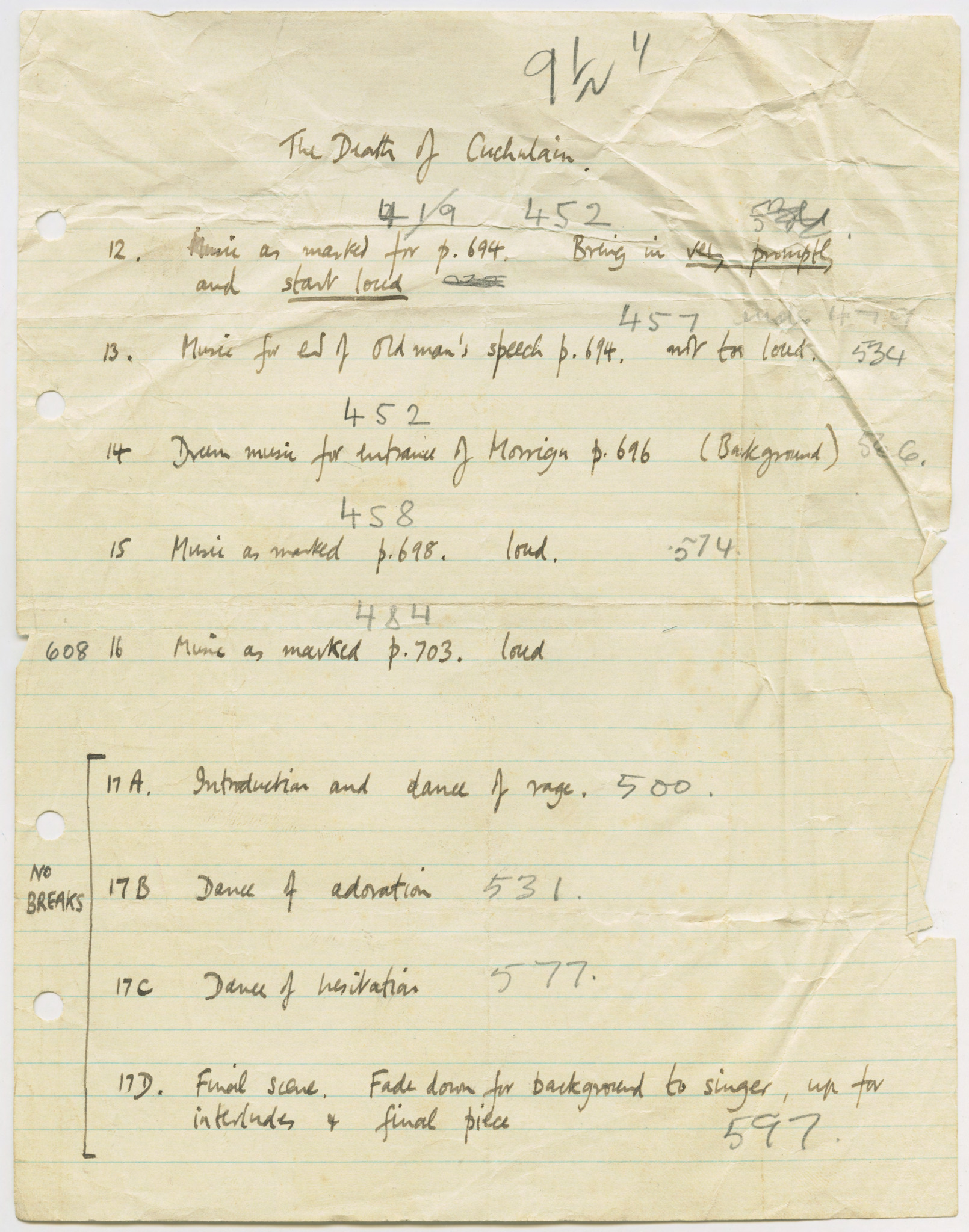
Handwritten note on the 'Death of Cuchulain' music and
 dance sets, Lyric Players Theatre, 1959,

The Cuchulainn Cycle performed by the Lyric Players, 1978

Programme from the 10th Anniversary 
Cuchulain Cycle by the Lyric Players, 1978.


The literary journal, Threshold, of which Mary O’Malley was the founding editor provided more fertile ground for the exploration and discussion of the themes of W.B. Yeats’ plays and poems. The first issue of Threshold, edited by O’Malley, and all subsequent issues, carried a quotation on its inside cover from W.B. Yeats’ The King’s Threshold:

              Cry out that not a man alive

              Would ride among the arrows with high heart,

              Or scatter with an open hand, had not

              Our heady craft commended wasteful virtues.

In her foreword to the first issue in 1957, O’Malley wrote:

The history of Irish periodicals is not encouraging. Despite high literacy standards and imaginative presentation of general topics, few have survived. No one, however, would deny the value of their contribution to creative writing and objective criticism. It is hoped that Threshold will provide a medium for a further contribution.

Centenary flyer from 
Lyric Platers' Centenary 
Celebration  of W.B. Yeats.


In a later editorial for Threshold in 1958, O’Malley again outlined for artistic vision which straddles the poet and the theatre as a dual form of complementary expression, stating that: “The theatre links the writer and artist with the craftsman and ordinary citizen more intimately than any other medium.”. In the centenary year of the birth of W.B. Yeats in 1965, Roger McHugh guest edited a special issue of Threshold which was dedicated to the work and life of W.B. Yeats and to which Mary O’Malley contributed an essay on the plays of W.B. Yeats. A full run of the journal, as well as its administrative correspondence are all collected within the Lyric Archive.

The Lyric Theatre also has a long association with the Yeats Summer School is Sligo. The group performed at the inaugural summer school in 1960. The archive has play programmes, photographs from that visiting production to Sligo in 1960 and files of correspondence between the Lyric and the Summer School through subsequent decades.

The Lyric Players performing at the first Yeats Summer School, 
Sligo, 1960. 


The first dedicated biography of O’Malley, entitled “Fierce Love”, was recently published by former journalist and writer Bernard Adams. In his description of his subject, Adams wrote that:

Mary O’Malley wanted to change the world. In 1947 she came up from the South of Ireland to live in a place which badly needed changing – the Unionist-dominated statelet of Northern Ireland. She wanted to transform her Belfast world, politically and culturally.

The many legacies of Mary O'Malley, and of her work with the Lyric Theatre lives on through the Lyric in Belfast today, as well as through the Lyric archive at University of Galway. The archive material relating to W.B. Yeats is indispensable to the study of how Yeats's work for the theatre was produced and directed by one of modern Ireland's greatest Yeatsians, Mary O'Malley. 

The O’Malley/Lyric Theatre Archive catalogue can be searched here.

An selection of digitised material from the Lyric Archive can be viewed online here.

Mary O'Malley, pictured at the Lyric Theatre on Ridgeway Street
c. late 1960s. Lyric Archive.