Showing posts with label James Hardiman Library Archives. Show all posts

Monday, November 28, 2016

Podcast: Prof. Frank Shovlin - Mining the Literary Archive of John McGahern

Welcome to this podcast from the Archives of the Hardiman Library, NUI Galway. This episode features a conversation with Professor Frank Shovlin, who shares his experiences and thoughts from extensive research carried out on the archive of writer, John McGahern.

Prof. Frank Shovlin
Frank was educated at University College Galway where he took BA and MA degrees before moving to complete doctoral studies at St John's College, Oxford. In 2008 frank became a senior lecturer at the University of Liverpool and in 2014 took up the role as head of department at the Institute of Irish Studies at the University of Liverpool.

Frank has earned numerous competitive fellowship awards, notably Leverhulme Study Abroad Fellowships and Moore Institute Visiting Fellowships which enabled detailed study of the Archive of John McGahern.

Frank has published widely in leading journals and publications on Irish literature, print culture and related topics. Previous monographs include "The Irish Literary Periodical 1923-1958" ; "Journey Westward: Joyce, Dubliners and the Literary Revival" and Frank's most recent monograph is entitled "Touchstones: John McGahern's Classical style"

Items from the McGahern Archive at NUI Galway
In this conversation Frank discusses his engagement with the archive of the archive John McGahern and how that archive has influenced Frank's research.


Wednesday, November 23, 2016

Did a Hollywood star come to UCG in 1928? - Explore Archives

The visitor book of Queens College Galway/University College Galway is a record of all guests and notable visitors to campus for the years 1877 - 1928. A simple volume like this was in use when the campus comprised only the Quadrangle building we know today but carries huge significance within the hundreds of signatures within its pages. The book covers a span of years that was revolutionary, in many senses, in Ireland and for the University with its place within the network of 'Queen's Colleges' of Ireland and the U.K.

Through the years the book was in use, it witnessed the growth of the University, the rise and fall of Charles Stewart Parnell, the reign and later death of Queen Victoria, the 1916 Rising which had ripple effects across the west, the first world war which saw staff and students of the college enlist and also die on the battlefields of Europe, the 1918 Election, and other major events through the Revolutionary period in Ireland, through to the late 1920s.

The book has been on display in the Archives and Special Collections Reading Room for much of this year as a centre-piece of the exhibition, "A University in War and Revolution: 1913 - 1919". A truly unique occurrence happens in August 1899 when both Pearse brothers, Padraig and William, sign the register as visitors to campus. It is a rare occasion in history where both brothers' signatures are signed side-by side.

Signatures of the Pearse brothers, QCG, 1899


However, another curiosity occurs at the very last entry in the book. Dated 1928 is the signature of 'Douglas Fairbanks', Hollywood, Cal[ifornia]." There is no available information as to why Fairbanks, one of the most celebrated actors of his generation at the time was at UCG. Fairbanks was married to actress Mary Pickford at the time, who had Irish roots. Was he here as a guest of the President of the University or an academic? Was he on holidays in the region at the time? Or was the signature a prank by a student of the day?! Any film buffs out there who might have any clues, do let us know.
Signature of Douglas Fairbanks, UCG, 1928


Friday, December 4, 2015

Explore our unique Archives Collections online!

We recently introduced a new web interface through which you can browse the archives collections of the James Hardiman Library online.

Here are 5 ways in which your research could be transformed by this exciting new development!

1. Archives are amazing sources of inspiration. They hold an abundance of potential research material that can be applied to virtually any discipline to create innovative research. The catalogue could hold the key to unlocking your next research project, and you will never know unless you look!

2. Even if you don't unlock your next research project, simply by browsing through the Showcase and Image Gallery sections of the page, you are certain to find out about something or someone new.

3. The enhanced search functionality afforded by this new service means you can carry out keyword searches across the entire catalogue. This means you can browse over 20,000 records from 350 collections simultaneously, bringing insights from other sources to light that you may not have considered before now.

4. The archives catalogue is one part of a new suite of tools aimed at opening up our archives. Why not look at the catalogue alongside some of our digital projects which are available on https://digital.library.nuigalway.ie/. Keep an eye out for new projects on this page, and you can still find our older digital projects on http://www.library.nuigalway.ie/digitisedarchives/. These will be migrated to the new system soon.

5. Finding something you are interested in on our catalogue gives you the perfect excuse to work in our beautiful reading room, located on the ground floor of the Hardiman Research Building in the heart of NUI Galway's campus.

Check it out now on http://archivesearch.library.nuigalway.ie/. Happy Browsing!


Monday, October 5, 2015

Brian Friel - An Appreciation

It is with great sadness that we note the laying to rest of Brian Friel yesterday. A quick look through our archival holdings shows the range and influence of Brian as a playwright and a friend to various theatre people for well over fifty years. From writers such as John McGahern and Thomas Kilroy, to a variety of theatre companies and actors, the energy and enthusiasm he brought to Irish theatre is clearly visible. In September 1963 the Lyric Theatre staged "The Enemy Within".


Featuring George Mooney in the role of Columba, it was one of a number of plays staged by the Lyric Theatre Company from young emerging Irish writers in the late fifties and early sixties.


Another play which features strongly in our collections is the "Loves of Cass Maguire". Siobhan McKenna's role as Cass in the Abbey's 1967 production introduced one of the most enduring characters to an Irish audience.


It was also one of the plays staged by the Druid Theatre Company in their opening production in the Summer of 1975, revived in 1996 for the 21st anniversary production, both productions starring Marie Mullen.

  
The Abbey Theatre Digital Archive, uniquely available at NUI Galway, captures the legacy and engagement of Brian Friel with Ireland's national theatre. The Abbey would première some of Friel's most powerful plays from the 1970s to present day, including The Freedom of the City (1973) Volunteers (1975) Living Quarters (1977) Dancing at Lughnasa (1990) Wonderful Tennessee (1993). The Abbey archive contains scripts, prompt scripts with detailed annotations, posters, programmes and recorded videos of performances of many of Friel's landmark works.

With around ninety references to Brian in our archives catalogue, why not take a virtual tour through our holdings to appreciate the impact of one of Ireland's great playwrights on Irish theatre. Visit: https://archivesearch.library.universityofgalway.ie/

Tuesday, August 26, 2014

Land - Ownership, Occupancy & Use: the O'Connor Donelan Archive

Letter from John O'Connor Donelan to his mother
21 July 1893
Land–its ownership, occupancy and use– has been a central motif in Irish history and in the Irish imagination for centuries. Land has been a source of wealth and income, as well as a key marker of social rank and political power. A history marked by confiscation and plantation resulted in the land being a site for conflicting claims and identities in Ireland. Accordingly, primary documentary records relating to Irish landed families and estates provide a rich resource for the investigation of many aspects of Irish history. 

The Archives of the Hardiman Library hold a number of landed estate collections relating to major estates and families in the West of Ireland. The O’Connor Donelan collection provides a good example of the value of such records. The papers relate to the O'Connor Donelan family of Sylane, Tuam, County Galway. The papers cover the legal dealings of the family, the management of their various lands, and personal papers relating to various family members. The bulk of the personal material relates to Thomas O'Connor Donelan (1812-1874) and his sons. His eldest son Dermot had an interest in genealogy and forestry, and his other three sons were doctors in Dublin, Leeds and Manila.
Thomas O'Connor Donelan,
c. 3 years old, c. 1870

A Galway landowning family, the O’Connor Donelan family papers relate principally to the nineteenth century, though reflecting the activities of both the Donelan and O’Connor families in earlier centuries. The papers document various aspects of the lives and range of interest and responsibilities of the family: the legal aspects of their affairs, the challenges of estate management and the personal concerns (including political activities) and contacts of family members in the nineteenth century. The collection offers the researcher a valuable case-study of a modest Galway landed estate of the nineteenth century.

Also available online from NUI Galway is the Landed Estates web site, www.landedestates.ie, a comprehensive and integrated online resource guide to landed estates and gentry houses in Connacht c.1700-1914.


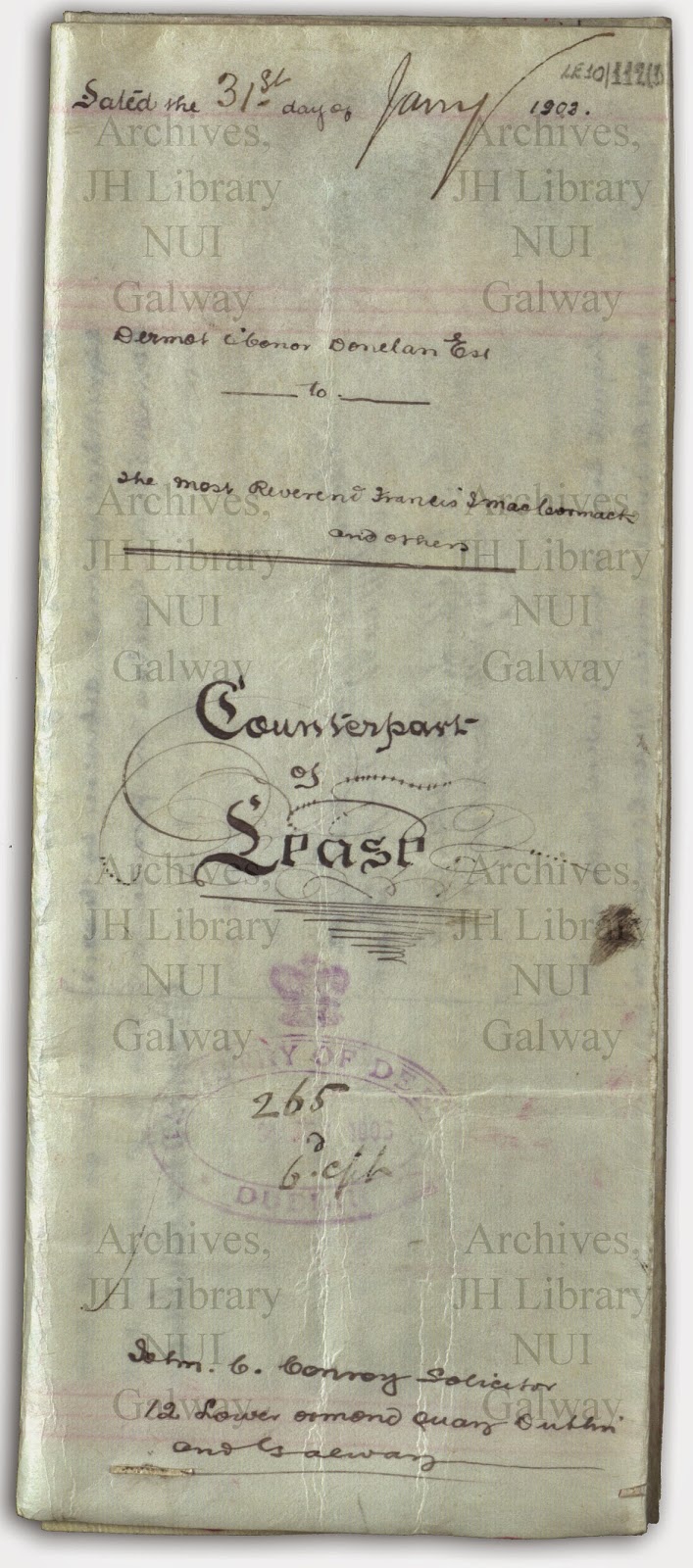
Lease for Cuilmore [Peterswell, County Galway]., containing three acres, for use as a priest's residence for 999 years, at £11 per annum. 31 January 1846


Thursday, November 28, 2013

Father Alec Reid laid to rest

Press cutting from the Sunday Times
21 April 2002
The Brendan Duddy Papers
The funeral of Father Alec Reid took place yesterday, giving us pause to reflect on the key role he played in the Northern Ireland peace process, and on the importance of dialogue in times of conflict.  In among the Brendan Duddy papers, we came across a newspaper clipping profiling Father Reid, and his work in brokering peace in the Basque region.  Here in Ireland, he is remembered most as being a key figure in bringing The Troubles to an end, and as an icon for peace in one of the most enduring images from The Troubles, where he is photographed praying over the bodies of two British soldiers.  Father Reid was a powerful ambassador in convincing people that dialogue was the only true way to resolve conflict.  Ar dheis Dé go raibh a anam.

Thursday, May 30, 2013

Looking forward to and back at the Galway Arts Festival

The annual celebration of all things creative and cultural, the Galway Arts Festival, has unveiled its program for 2013, which along with the sun shining high (as of time of writing!) is really marking the beginning of Summer here in the West.

The archive of the Galway Arts Festival, covering 33 boxes of archive material and over 200 posters, is deposited with the Archives and Special Collections Service of the James Hardiman Library, NUI Galway. It is a record of the beginings, growth and evolution of the festival, it's events, memories, people and stories.

Galwa Arts Festival Poster 1991
The Galway Arts Festival was first staged in 1978. It was the culmination of the efforts and ideas that grew out of the University College Galway Arts Society. Ollie Jennings became auditor of this society, taking over from Garry Hynes, who became one of the founders of Druid Theatre Company. Under the direction of Ollie Jennings, this group, which included Paraic Breathnach, Marie Mullen and others, went on to become the Galway Arts Society. This new group set out to become a voice for the Arts in Galway and strove to find a permanent home for a dedicated Arts Centre in Galway City. Further to this was the aim of setting up an annual Arts Festival for Galway City. The first Galway Arts Festival was staged from the 6th to the 12th April 1978. It was described by Dickie Byrne in the Galway Advertiser as 'Galway Arts Society's Week of Craic'.

The central venue was one of John Murray's converted antique rooms between Raftery's Store and the old Genoa (Nora Barnacle's) The line-up at this original Galway Arts Festival included readings by John McGahern, Paul Muldoon and John Hewitt, the opening of film by Bob Quinn entitled Poitin, instillations from visual artist James Coleman and puppet theatre from Jay Murphy and Brian Bourke. Following the success of this first Galway Arts Festival, it was expanded in 1979 and received an increased grant from the Arts Council. An additional Festival space was also opened up for use at the old Pro-Cathedral.

The Galway Arts Festival is today one of the most diverse and successful arts festivals anywhere in the world and is a highlight on the Irish Arts calendar. Over the coming months and in the lead up to the Festival we will bring you some highlights, memories and great images from great festivals past and recent.

The above image, being the GAF official poster image for 1991 is just one great image and we hope to bring you many more!

Wednesday, February 20, 2013

O'Connell Bridge, Dublin, 1950s - Ritchie/Pickow Archive

This wonderful image of a crowded O'Connell Bridge in Dublin is part of the Ritchie-Pickow photographic archive at the James Hardiman Library, NUI Galway. The image dates to the early 1950's and is a clear scene of a bright morning on Dublin's busy main thoroughfare.


Jean Ritchie, singer, folklorist and dulcimer player was born on 8 December 1922 in Viper, Kentucky. She was the youngest of a family of 14 children, known as .The Singing Ritchies. Jean graduated from the University of Kentucky in 1946 and taught for a time. In 1952 she was awarded a Fulbright Scholarship to enable her to research the origins of her family's songs in Great Britain and Ireland. Her husband George Pickow, a photographer, accompanied her and they spent approximately eighteen months recording folk songs and traditional musicians and taking photographs. The photographs include photographs of many well-known uileann pipe players, for example Seamus Ennis, Michael Reagh, the McPeake trio, Leo Rowsome; vocalists, including Elizabeth Croinin, Sarah Makem and Mary Toner and story tellers, such as Patcheen Faherty from the Aran Islands.

As well as assisting his wife in her research George Pickow also used the opportunity to do features on aspects of Irish life, Christmas celebrations with straw boys and wren boys, life on the Aran Islands, Dublin scenes, the American Ambassador and his family in Ireland, the story of St Patrick, the development of Dublin Airport, operations of the Garda Síochána at Dublin Castle, and Irish sporting activities, such as road bowling, hurling, coursing, hunting and racing. Photographs were also taken of traditional Irish crafts, for example spinning, weaving, thatching and crios and sliotar making. In a video recording made with George and Jean Pickow in the early 1990s regarding their visits to Ireland, George says that these photographic stories were for the Sunday News  in New York.

The photographic archive is comprised of one hundred and sixty seven sheets of black and white contact prints with corresponding negatives, numbering one thousand eight hundred and eighty seven photographs in total. The majority of the photographs were taken using Kodak safety film and these negatives are unfortunately not numbered so the sequence cannot be followed. The last ten sheets of photographs were taken using Eastman 5 6 super xx safety film and Ilford hypersensitive panchromatic film, these negatives are numbered. There are also one hundred and ninety prints in two sizes, 19x19 cms and 27x27 cms, of which ninety five are mounted.

To see more images from the Ritchie-Pickow Archive click here

Visit the home page of James Hardiman Library Archives at NUI Galway here


Monday, November 12, 2012

Launch of Music for Galway Archive Catalogue


The archive of Music for Galway has been catalogued here at the James Hardiman library, National University of Ireland Galway. The archive will offer researchers a unique insight into the establishment and growth of one the West's premier music groups while documenting the creative and administrative processes of Music for Galway's numerous achievements.


The archive ranges in date from 1981 to 2011 and includes numerous series of original records documenting the Irish and international acts that played to audiences across Galway and the West of Ireland. The archive traces the relationship between Music for Galway and National University of Ireland, Galway, as the group found a home for concerts and their grand piano at the Aula Maxima on the University's campus.

The archive consists of nineteen boxes of records comprising of a comprehensive record of Music for Galway's legacy. The archive includes records of productions including posters, flyers, invitations, programs and press releases; numerous black and white and also colour photographs of Music for Galway committee members and also of musicians and concerts, financial records, details of membership and rates, correspondence between Music for Galway and various musicians and groups, Music for Galway Newsletters and press cuttings of news and coverage of concerts and events.

The archive will be launched by Erika Casey, founding member of Music for Galway and the evening will include an exhibition of material from the archive, an overview of the archive material and a performance from Con Tempo Quartet. A reception will follow this performance. The event will take place at the Aula Maxima, NUI Galway, 19th November, 6pm.

For more information or to RSVP, contact archivist barry.houlihan@nuigalway.ie

Tuesday, October 23, 2012

Learning the Ropes - Walter Macken and Taibhdhearc na Gaillimhe in the 1930s

It is perhaps true to say that Walter Macken is always identified to the flowering of activity at Taibhdhearc na Gaillimhe in the 1940s. He was a central figure in this development, bringing industriousness and a drive to the theatre that encouraged others to get involved. However, this role did not occur within a vacuum. It has to be viewed within the context of the evolution of Taibhdhearc na Gaillimhe in the 1930s, and what Walter Macken learned at the Taibhdhearc from 1933 to 1936, and in particular what he learned from the producer at the time, Frank Dermody. We will then look briefly at his return as artistic director, and everything else that he did to promote the theatre and Irish language drama at the time. In his semi-autobiographical novel Sullivan (1957) he wrote:


He worked an average of twelve to fourteen hours a day . . . He designed and painted the scenery, he made flats and stretched the canvas on them, he kept the accounts, drew up the advertising, learned off long parts, trained raw actors to become presentable . . . He did all this for a feverish love.

He not only acted as administrator, dealing with the day-to-day running of the theatre, dealing with the Board of Directors and everything else, but also dealt with every aspect of the artistic process of the theatre, from getting production rights, to translations, to casting, set design, rehearsals, publicity and productions, as well as doing much of the acting himself.

The idea of an Irish language theatre had been around as a possibility for some years before it’s actual establishment in Galway in 1928, and it was the culmination of many years endeavour. Writing in May 1919 in Fáinne an Lae, Tomás Ó Máille (Professor of Irish language, Philology and Literature at UCG from 1909 to 1938) outlined their reasons for seeking an Irish language theatre in Galway.

Tá lucht cabhartha na Gaedhilge sa mbaile seo le tamall ag cur rompú taidbhdhearc Gaedhealach agus cuallacht taidhbhreadóirí a chur ar bun I nGaillimh le drámanna nó taidhbhréimeanna i n-ár dtrangaidh dhúthchais a thaidbhsiú agus a fhiorléarú i nGaillimh agus ar fud na hÉireann.
Other sponsors of the plan included Fr. Tomás Ceallaigh, Dr. Séamus Ó Beirn and Liam Ó Briain (Professor of Romance Languages at UCG, 1917 – 1958). Given the unstable nature of the country in the 1920s, however, this early attempt fell into abeyance. Several of the theatre supporters were on the run, some were imprisoned, including both Ó Briain and Ó Máille.

The idea of an Irish language theatre was revived in 1927. Galway was viewed as an ideal location for an Irish language theatre, because of it’s proximity to Ireland’s largest Gaeltacht as well as its concentration of Irish-speaking institutions. The city had a large Irish-speaking population, An Céad Cath (the Irish speaking battalion of the Irish army stationed at Renmore) and a large number of Irish language enthusiasts and scholars at University College Galway. A committee of eleven was formed, and the project benefited from the personal interest of the then Minister for Finance, Ernest Blythe, who was keen to establish the cultural credentials of the Irish language within the new Irish state. The committee approached Micheál Mac Liammóir to act as artistic director, and he did most of the early plays from 1928 to the end of 1930, before committing to the development of Dublin’s Gate Theatre with Hilton Edwards.

There had been a decline in the number of plays produced in the theatre in 1930, reflecting Mac Liammóir’s reduced involvement and it was clear that replacement producer-directors were needed. At the end of 1929 Blythe and Richard Maulcahy (Minister for Defence) arranged for Prionsias Mac Diarmada, a corporal in An Céad Cath, to transfer to Cathal Brugha Barracks and learn production skills at the Gate Theatre with MacLiammóir and Edwards. MacDiarmada (later known as Frank Dermody) had joined the army in 1923 and had been involved with the Taibhdhearc from an early stage, having played the part of Oisín in their first production Diarmuid agus Gráinne.

At the end of 1930 the Committee was cut down from eleven to 3, and it was decided to appoint Frank Dermody as Manager and Secretary. His appointment certainly met with the approval of Ernest Blythe, who commented in a letter to Liam Ó Briain in a letter of 11th February 1931 “I am satisfied that the arrangement which has now come about is the only one under which Taibhdhearc na Gaillimhe has a chance of developinig as it ought to develop”. Mac Diarmada’s first production was J.M. Synge’s Deirdre of the Sorrows (Deirdre na mBróin), translated by Ó Briain. Supported by Tommy King in the more practical aspects of organising the theatre, Mac Diarmada brought an energy and enthusiasm to the job that ensured a good selection of actors and a wide spectrum of productions. Tensions within the Board of Directors centred on the what productions should be done, Ó Briain favoured translations of European works with comparable Irish language plays, Ó Beirn’s focus wanted more kitchen-comedy style plays to build support for the theatre. Mac Diarmada and Ó Briain did not always see eye to eye either, although Ó Briain was instrumental in keeping the Departments of Finance and Education onside with the theatre’s activities.

Bríd Ní Gríofa and Mairtín Ó Direáin in a scene from Deirdre na mBróin by J.M. Synge [Taibhdhearc na Gaillimhe Collection, James Hardiman Library Archives, T1/E/1].
Although there may have been disagreements on the board and it was operating on a shoestring budget, the Taibhdhearc consolidated it’s position, due in no small part to the hard work of Mac Diarmada. The productions from the 1930s staged by Taibhdhearc na Gaillimhe included translations, both continental and English plays, as well as original drama in Irish. Other initiatives at the time included the involvement of the players in radio plays with Radio Eireann, and a steady stream of original drama in Irish through An tOireachtas, who ran a competition each year.
It was into this setting, then, that Walter Macken entered. His first acting role with Taibhdhearc na Gaillimhe was at the age of 17, when he played the role of Sean-Mhaitias in Pádraig Pearse’s Iosagáin. In the play Iosagáin visits Sean-Mhaitias who is too sick to go to Mass, but he receives hope of solace. It is a sign of Macken’s versatility at this early stage that he was also credited with set design for the play, which ran from the 12th to the 14th December 1933. The play was billed in The Connacht Tribune as an experiment with the boys of St. Ignatius’ College, saying that the public were in for a treat: “it is confidently expected that they will agree that the experiment was justified when they realise what our youth are really capable of” (9 Dec 1933). This would indicate that it was through his school that Walter was first introduced to the Taibhdhearc, and his activity in this production clearly impressed Mac Diarmada.

Walter’s versatility was underlined in March 1934 when he co-wrote Ceart agus Cáiteamh (Mayor Lynch of Galway) based on the story of James Lynch, the 15th century mayor of Galway who infamously condemned his own son to death for having murdered a young Spaniard. Billed as “triumph and tragedy” in medieval Galway, with a cast of fifty and eleven scenes, it was noted that “Mr. Walter Macken collaborated with Mr MacDiarmada in the writing of some of the scenes of the play”.


Scene from Ceart agus Cuiteamh by Prionnsias Mac Diarmada and Bhaitear Ó Maicín, featuring Maire Ni Giolla Mhairtin and Uinsionn Ó Mathuna, Mar 1934 [Taibhdhearc na Gaillimhe Collection, James Hardiman Library Archives, T1/E/6].

With Walter’s acting skills being put to good use in various productions, it is no surprise that he took the title role in a show-case production to mark the first seven years of the Taibhdhearc. MacDiarmada’s production of Beatha Iogantach Bhearnáird Óig de Menthon by Ghéon, with its lavish costumes and set, made a statement about the new confidence of the Taibhdhearc. Eamonn de Valera attended the opening night, which coincided with the unveiling of a statue of Pádraic Ó Conaire in Eyre Square. The Connacht Tribune review noted “the central figure of the drama, St. Bernard, was admirably played by Bhailtear Maicin. Mr. Mackin showed admirable restraint in St. Bernard’s mental battle against worldy lives – a restraint which held him from overstepping the bounds into rant”. Seamus O’Sullivan, the noted sculptor who had been involved in the foundation of the Abbey, found Macken’s performance outstanding, and as good as anything he had seen since the heyday of the Abbey.

Walter was next noted as an actor in Na Cruiteachán a translation by Liam Ó Briain of La Farce des Bossus by P Jalabert. In the play a young wife who is married to a miserly man invites a group of wandering musicians in to keep her company. Walter played on of the musicians. It was the first radio-play broadcast by Radió Éireann using the Taibhdhearc, and it was broadcast on Wed. 10th July 1935 at 8pm. It reflects Mac Diarmada’s forward thinking that it was the first of a series of broadcasts, and the fact that he was aware that he was competing with film and provincial theatres to draw an audience into the Taibhdhearc.

Cast list from Na Gaduithe by Gearóid Ó Lochlainn, featuring both Walter and Peggy on the cast list, December 1935 [Taibhdhearc na Gaillimhe Collection, James Hardiman Library Archives, T1/D/39].

One interesting review from The Connacht Tribune comes the following December, when, in a review of Na Gaduithe, the Gearóid Ó Lochlainn play, there was a detailed review of most of the characters. The basic premise, two investigators come to a Gaeltacht hotel on the tail of two robbers, and fall in love with the hotellier’s two daughters. Walter played the role of Brian Ui Neill and Padraic Breathnach played the role of the other investigator, the two daughters were played by Eibhlin Ni Suilleabhain and Peigi Ni Chionnigh. The review of Walter’s role is telling, probably pointing to the writer of the review as Peigi, the only person not to get a detailed review of her performance.

Uaitear O Maicin gave a very good performance as Brian. The young man who was able to move around and enjoy himself while conducting his investigations into the robbery. His scenes with Eibhlin were good, but we were inclined to wonder what passed through his mind when, on the garden scene, he told Eibhlin of his love and was accepted. His smile did not seem to us one of happy contentment.
Walter continued to be a stalwart actor for the Taibhdhearc from 1936 and into 1937, with over thirteen productions in that year it was clear that Mac Diarmada’s industriousness was paying off, and that he was catering to a number of different ideas coming from the Board of Directors. For Walter, acting in Deireadh an Aister (Journey’s End) by R.C. Sherriff and translated by Aodh Mac Dubhainn, must have been particularly poignant given its setting in the trenches of World War One.

Cast list for Mayor Lynch of Galway by Frank Dermody, produced in Galway by the Art Players, 18-19 October 1935 [Christopher Townley Collection, James Hardiman Library Archives].

Walter’s last role in this phase of his involvement with the Taibhdhearc was in January 1937 was Grádh an Spréidhe (Sovereign Love) by T.C. Murray, translated by Mairtín Ó Direáin. Again, the reviewer in The Connacht Tribune was fulsome in their praise of his acting
Uaitear Ui Maicin carried the honours of the Taibhdhearc production. This young actor who has innumerable successes to his name, gave a delightful reading of Domhnall O Cearnaigh, the old farmer who seeks to secure a good “fortune” with his prospective marrying in son-in-law.
The following month he and Peggy had married in Dublin and had moved to London. In a reference written the same day as his marriage, Prionsias Mac Diarmada wrote in glowing terms on his work as leading man and business manager for the theatre, commenting that he had taken leading roles in thirty full length and thirty-six one act plays.

Mr. Macken is in my opinion the most outstanding character actor (comedy or tragedy) in Ireland today not excluding the Abbey Theatre. My contention may be substantiated by a perusal of many press notices which he has received. As regards his personal character I have always found him to be honest upright and trustworthy in every respect.
That thirteen plays were produced in 1936 and 18 more in 1937, bears testimony to the industry of the theatre and to Mac Diarmada’s tenure as producer-director. When Mac Diarmada was appointed as Director of the Abbey School of Acting in October 1938, he moved to Dublin and eventually succeeded Hugh Hunt as producer at the Abbey. An appreciation written following his death in 1978, noted that: “During his years in Galway he devoted all his time and unquestionable talents to bringing the Taibhdhearc into national prominence (Connacht Tribune, 11 July 1978).

Black and white photograph from Aintín Searlaí (Charley’s Aunt) by Brandon Thomas, featuring Eibhlín Ni Suileabháin and Micheál Ó Beirn, produced by Walter Macken [Taibhdhearc na Gaillimhe Collection, James Hardiman Library Archives, T1/E/8].

Walter Macken’s association with the Taibhdhearc ended until 1939, when he returned as Artistic Director. His undoubted ability from his time as an actor there, his and Peggy’s wish to return to Galway, and the support of elements within the Board of Directors and Mac Diarmuda, all came together to support his return. In a meeting of 8th April 1939 Captain Ó Concubhair proposed that Uaiteár Ó Maicín would produce the next production and that the Directors would get a sense of whether he was a suitable producer for the theatre. The following meeting, on the 26th April it was noted that his first production would be Charley’s Aunt by Brandon Thomas, and at the following meeting it was proposed by Dr. Tomas Breathnach that Walter Macken would be appointed director at £3 a week, and that he would be sent to the Gaeltacht in August to improve his Irish. He moved on to become one of the most successful artistic directors of the long history of Taibhdhearc na Gaillimhe, before moving to the Abbey Theatre as an actor, later becoming a prolific writer.