Showing posts with label Belfast. Show all posts

Tuesday, June 13, 2023

W.B Yeats, Mary O'Malley, and the Lyric Theatre - "Look Up in the Sun's Eye"


'Yeats Day' on the 13 June annually has become a day of celebration of the works and life of Ireland's Nobel-Prize winning poet, W.B. Yeats. It is also a timely opportunity to reflect on others who have made important contributions to the engagement, study, and interpretation of Yeats' works, including the considerable body of plays written by Yeats. One key person in this regard is Mary O'Malley. Born in Cork in 1920 and later the founder of the Lyric Players Theatre in Belfast, along with her husband Pearse, the production and direction records of O'Malley, combined within other series of files within the O'Malley/Lyric Archive at University of Galway Library, provides a vital insight into Mary O'Malley's artistic vision as well as into her own work and processes as a director of Yeats' plays.

Mary O'Malley at Yeats' grave, Sligo. c. 1960

The first production of the Lyric Players Theatre took place in March 1951 and included a production of W.B. Yeats’ At the Hawk’s Well at Ulsterville House. With the O’Malley family soon moving house to a premises on Derryvolgie Avenue, it afforded the emerging group a new beginning. Space on the grounds of the house that lay over a converted hay loft were divided into two rooms which became the theatre site for the Lyric Players.

Already greatly influenced by W.B. Yeats and poetic theatre (such as that by Austin Clarke and his earlier Dublin-based Lyric Theatre Company, where O’Malley had attended performances previously), she was a committed producer and director of Yeats’ plays at her theatre in Belfast. In combining the visual, the aesthetic, as much as the lyrical, Yeats’ plays found a invigoration home of experiment and form at the Lyric, through Mary O’Malley, and with a host of important contributions in acting, design, choreography, music, and form, while keeping the poetic theatre at the heart of Yeats’ original vision to the fore. Mary O’Malley recounted that the first production of Yeats in 1951 was an important touchstone for the development of the artistic vision, policy, and repertoire of the Lyric Players and later its later theatre:

The stage was set and we endeavored to create a style suitable for dramatic poetry. This work and experimentation still goes on. Artistic activity attracts like the enchanted waters of the Hawk’s Well – the ultimate, always elusive. This, then, was the reason for beginning: a handful of people interested in the theatre, poetry and the arts, inspired by the legendary Ulster hero, ignored all obstacles and founded a Poet’s Theatre”.

The studio theatre, DerryvolgieAvenue, 1960s


Music score from 'Calvary', Lyric Players, 1954


The archive of the O’Malley/Lyric Theatre Belfast contains a vast record of the growth and development of the Lyric Theatre, the tireless work of Mary O’Malley and of her husband, Pearse O’Malley, in ensuring the theatre’s artistic and cultural expansion. The Lyric was more Arts Centre that ‘just’ a theatre as at various times in the 1960s and 1970s its ran an art gallery, music and drama school, craft shop, as well as publishing a highly significant literary journal, Threshold, which ran until its final issue in 1990. The Lyric Archive is also an indispensable source of information on the study of and production of Yeats’ plays. The archive has detailed records of numerous productions of Yeats’ plays from the 1950s onwards.

One remarkable archive item is Mary O’Malley’s personal copy of The Plays of W.B. Yeats. Every page of the volume is filled with detailed annotation, production notes, direction comments, as well as sketches and drawings of stage designs. The item presents itself as a handbook for the director interested in engaging with the vision and task of staging Yeats’ often experimental form. In discussing the directing of Yeats’ O’Malley once commented on the importance of voice to the actor when interpreting Yeats’ theatre: “Only those well-disciplined in speech and movement can be utilised . .  . lines must be clearly and unselfconsciously delivered.”

Mary O'Malley's annotated edition of
"The Complete Plays of W.B. Yeats".

Mary O'Malley's annotated edition of
"The Complete Plays of W.B. Yeats".


Throughout the archive are detailed production records, including annotated production and design notes, musical scores, designs, photographs, programmes and posters from numerous Yeats productions at the Lyric. Design was also an important factor with artists like Alice Berger-Hammarschlag and Louis Le Brocquy all designing Yeats plays at the Lyric.

"At the Hawk's Well", Lyric Players Theatre, 1960

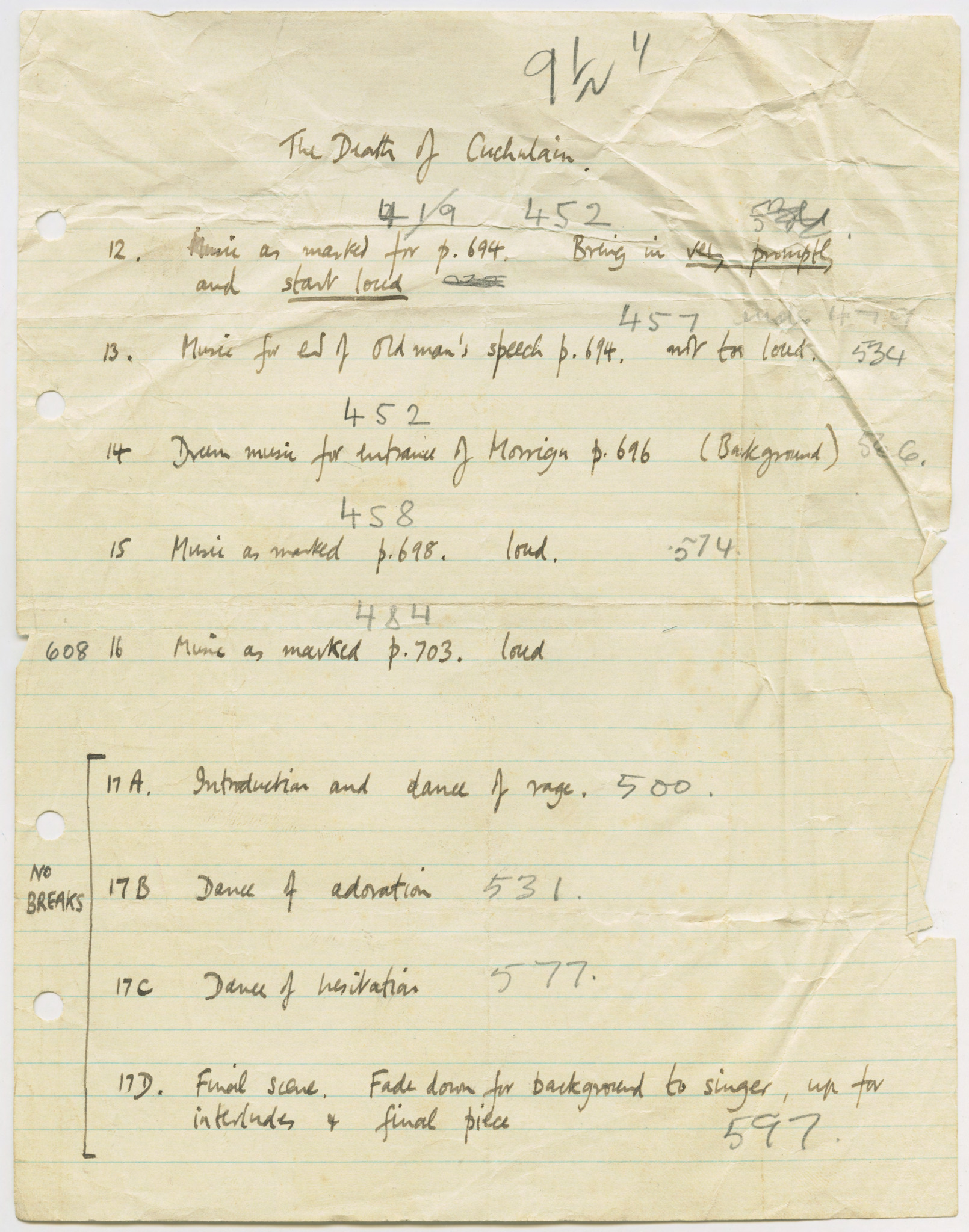
Handwritten note on the 'Death of Cuchulain' music and
 dance sets, Lyric Players Theatre, 1959,

The Cuchulainn Cycle performed by the Lyric Players, 1978

Programme from the 10th Anniversary 
Cuchulain Cycle by the Lyric Players, 1978.


The literary journal, Threshold, of which Mary O’Malley was the founding editor provided more fertile ground for the exploration and discussion of the themes of W.B. Yeats’ plays and poems. The first issue of Threshold, edited by O’Malley, and all subsequent issues, carried a quotation on its inside cover from W.B. Yeats’ The King’s Threshold:

              Cry out that not a man alive

              Would ride among the arrows with high heart,

              Or scatter with an open hand, had not

              Our heady craft commended wasteful virtues.

In her foreword to the first issue in 1957, O’Malley wrote:

The history of Irish periodicals is not encouraging. Despite high literacy standards and imaginative presentation of general topics, few have survived. No one, however, would deny the value of their contribution to creative writing and objective criticism. It is hoped that Threshold will provide a medium for a further contribution.

Centenary flyer from 
Lyric Platers' Centenary 
Celebration  of W.B. Yeats.


In a later editorial for Threshold in 1958, O’Malley again outlined for artistic vision which straddles the poet and the theatre as a dual form of complementary expression, stating that: “The theatre links the writer and artist with the craftsman and ordinary citizen more intimately than any other medium.”. In the centenary year of the birth of W.B. Yeats in 1965, Roger McHugh guest edited a special issue of Threshold which was dedicated to the work and life of W.B. Yeats and to which Mary O’Malley contributed an essay on the plays of W.B. Yeats. A full run of the journal, as well as its administrative correspondence are all collected within the Lyric Archive.

The Lyric Theatre also has a long association with the Yeats Summer School is Sligo. The group performed at the inaugural summer school in 1960. The archive has play programmes, photographs from that visiting production to Sligo in 1960 and files of correspondence between the Lyric and the Summer School through subsequent decades.

The Lyric Players performing at the first Yeats Summer School, 
Sligo, 1960. 


The first dedicated biography of O’Malley, entitled “Fierce Love”, was recently published by former journalist and writer Bernard Adams. In his description of his subject, Adams wrote that:

Mary O’Malley wanted to change the world. In 1947 she came up from the South of Ireland to live in a place which badly needed changing – the Unionist-dominated statelet of Northern Ireland. She wanted to transform her Belfast world, politically and culturally.

The many legacies of Mary O'Malley, and of her work with the Lyric Theatre lives on through the Lyric in Belfast today, as well as through the Lyric archive at University of Galway. The archive material relating to W.B. Yeats is indispensable to the study of how Yeats's work for the theatre was produced and directed by one of modern Ireland's greatest Yeatsians, Mary O'Malley. 

The O’Malley/Lyric Theatre Archive catalogue can be searched here.

An selection of digitised material from the Lyric Archive can be viewed online here.

Mary O'Malley, pictured at the Lyric Theatre on Ridgeway Street
c. late 1960s. Lyric Archive. 


Thursday, January 9, 2014

Brian Friel: Looking back to the Lyric Theatre, Belfast, of 1964

To mark the 85th birthday of the great playwright Brian Friel, we have dipped into the archives and are looking at how, 50 years ago in 1964, Friel was busy at work staging works in Dublin and Belfast. 


These letters and documents are from the Lyric Theatre/O'Malley Archive. The documents relate to the October 1964 production of The Blind Mice written by Brian Friel. This was the first and only production of the play at the Lyric Theatre and the play has since remained unpublished. The Blind Mice had received its Irish premiere in 1963 at the Eblana Theatre and produced by Orion Productions, which were founded by the late Phyllis Ryan. 

This extensive collection of papers relate to the foundation by Mary O'Malley of the Lyric Players Theatre in Belfast in the early 1950's and charts its growth from a theatre based in O'Malley's own house to becoming one of the most important cultural venues in Northern Ireland.


With specific reference to this 1964 production of The Blind Mice, the records of the Lyric Theatre archive contain the original and annotated scripts for the Belfast production, with scripts present marked "Stage Management",  "Lighting" and general copy with marked-up text of the play.

Also pictured here is a manuscript letter by Brian Friel written to Mary O'Malley written just weeks after the Belfast production of the Blind Mice and referring to the September 1964 and original production of Philadelphia Here I Come!  saying "The Dublin play went very well. It was one of those scripts that could have fallen flat on its face – and happily did not". Friel continues to outline his beliefs on writing a good satire and states where he falls somewhat short of his own expectations on this.


In the final paragraph of the letter, Friel wishes O'Malley continued good wishes for the Lyric Players Theatre: "Good luck with the new theatre – it could be great – and that is entirely up to you."

The Lyric theatre archive hold the following records for The Blind Mice:

T4/88 - Material relating to the production of The Blind Mice by Brian Friel at Derryvolgie Avenue. Includes two programmes and three copies of the script: a copy annotated with general production notes, a copy annotated with lighting directions, and a copy marked as being for the use of 'Stage Management'. This copy also has numerous notes and annotations. Also includes a portrait photograph of Sam Macready in costume as Father Chris Carroll.

The catalogue of the full Lyric Theatre/O'Malley archive is accessible here


Thursday, December 19, 2013

Christmas Greetings from the Archives

It's that festive time of year again and rounding off this semester it really has been an exceptional time of late here in Archives and Special Collections. Over the past semester, we have settled into our new home and premises here at the Hardiman Building; wonderful new collections have arrived into our strong-rooms, more have been catalogued and made accessible; it has been our pleasure to have you with us for Open Days, tours, Culture Night, exhibitions and launches, guest talks and more. We have been delighted to welcome so many new users to our Reading Room and indeed to welcome back all our regular users and friends! 
We hope all research and projects have gone well and not too many sleepless nights were had ahead of ahead of exams.

Our semester is winding to a close this week and already a new start is on the horizon so to all friends of the Archives and Special Collections, to users new and not so new, to all University staff and students and to those who visit us from afar, we wish you a very festive, enjoyable and safe Christmas and look forward to seeing you all here at the Hardiman Building in 2014.

As a final piece from our collections for this year here is an image from the Lyric Theatre Belfast production of 'The Nativity'. The production was a staging of the version written by Lady Augusta Gregory, organised and directed by Mary O'Malley prior to the formation of the Lyric Players Theatre.

T4/1 - the Nativity written by Lady Gregory, staged in 1950


Le gach dea-ghuí don Nollaig agus don bhliain nua.

Wednesday, October 30, 2013

Horror at the Lyric - Dracula on the Belfast Stage

The clocks going back, the evenings getting darker earlier and winter approaching are sure signs that Halloween is near. With television and cinema listings brimming with the latest horror movie or classic black and white (and perhaps not so scary) films of the past. It seems theatre audiences were no different in liking a good scare.

Programme cover of the Lyric production of "The
Death of Dracula"
 The archive of the Lyric Theatre, Belfast, shows a production of the Death of Dracula, a version of Bram Stoker's classic gothic novel , Dracula, by Canadian/English playwright (with the suitably spooky surname) Warren Graves. Staged at the Lyric as part of their spring Season in May 1980, the production was a European premiere of the play.

The programme note for the play, written by John Boyd, names Graves as being a founding member of Playwrights Canada and had a special interest in Irish drama, notably, Yeats, O'Casey and Brendan Behan. The play was directed at the Lyric by Tony Dinner and featured John Cunningham as Count Dracula, J.J. Murphy as Professor Van Helsing and Stella McCusker as Lucy Murray.

Graves was born in London, England 5 February 1933 and died in Lethbridge, Alberta, Canada in February 2008. Graves moved with his wife and two children to Calgary, Alberta in 1964, and then to Edmonton where he worked as an assistant clerk at the Alberta Legislature. He became a prominent theatre artist and administrator with Walterdale Playhouse before quitting his government job to become a self-employed writer in 1974. 

In a previous interview with the Canadian Adaptations of Shakespeare Project in 2004 when asked about the task of adaption for a playwright entailed, Graves answered:

"Tell a thumping good story that appeals to the common man, make sure it has a beginning, middle and an end, and get the bums on the seats. Respect language as gold and not copper coin to be tossed on the counter.
In my other adaptations, my job has been to make theatrically possible a story that exists in a different medium. I suppose my position about adapting a theatrical work that already exists as a theatrical work would be ––"Why bother?" Why not take the theme and storyline and use them to write an original work? I recall the story of a distinguished Hollywood writer producing an excellent script about a cattle drive for John Wayne and gurgling with delight because nobody recognized that it was an 'adaptation' of Mutiny on the Bounty."
Page of script from Graves' "The Death of Dracula"


The play is an interesting adaptation of an often told and re-told story and offers an archival record of this story of the dark Count once more. The full script of Graves' the Death of Dracula is available as part of the Lyric Theatre Archive, T4/257.

Cast and creative listing for "The Death of Dracula"


For more from the Lyric archive, see catalogue in full here.

Friday, December 21, 2012

The Nativity - Christmas Scenes, Lady Gregory and Douglas Hyde

Cover of The Nativity script by Lady Gregory

For a festive themed update from the archives of the James Hardiman Library, we delved into our collections and discovered this wonderful overlap between two of the most prolific of literary and political figures from the West, Lady Gregory and Douglas Hyde. The pair penned a version and  presentation of The Nativity which took to the national stage, the Abbey Theatre, in Dublin and to the stage of the Lyric Theatre in Belfast many years apart, but not without incident in between.

The play would begin its life by being written in Irish by Douglas Hyde in 1902 and translated into English shortly thereafter by Lady Gregory. However, it would be 1911 before the play would reach the Abbey Theatre stage in Dublin.

It is noted in Douglas Hyde – Maker of Modern Ireland (Janet Egleson Dunleavy and Gareth W Dunleavy, University of California, 1991) how on one of Hyde's many visits to Coole Park, the home of Lady Gregory in Galway, how Hyde's playwrighting was inspired by his muse – Gregory – and flourished while writing in quiet solitude in Coole Park. "In late August of 1902, [Hyde's] diary entry in Irish for (August 25) reads, "They shoved me into my room and I wrote a small play in three or four hours on Angus the Culdee. Entitled An Naomh ar Iarraid (The lost saint), it was published in the 1902 issue of Samhain and performed in early 1903. A first attempt to adapt for popular theater themes and characters from the Irish manuscript tradition, it drew upon Hyde's reading and research in ninth-century monastic Christianity, especially the legends that had been woven around the figure of Aongus Céile Dé (Oengus the Culdee).

Encouraged by the ease with which An Naomh had almost written itself, Hyde decided that his next subject would be the Nativity; his source, a medieval miracle play.

Dráma Breithe Chríosta, Hyde's nativity play, was finished within the month that followed and published in the Christmas, 1902, double number edition of the Weekly Freeman, accompanied by a translation in English by Lady Gregory. There was trouble about it almost from the start. A 1904 performance scheduled for Christmas had to be cancelled when it became the subject of a resolution passed by priests in Kilkenny, criticizing some questionable passages that they perceived as causing possible confusion between superstition and dogma. Continually refused for six years thereafter, Dráma Breithe Chríosta finally had its premiere at the Abbey Theatre in January 1911, with Sara Allgood as the First Woman, Máire O'Neill as the Second Woman, and Máire Nic Shiubhlaigh as Mary. The Abbey sets were designed by Robert Gregory, Lady Gregory's son.

The production charmed both audiences and reviewers. Other productions followed. For almost a quarter of a century—until the offending passages were blacked out in a school edition of the play printed in 1935—no one took notice of the problem that had troubled the Kilkenny priests."

The Nativity play as written by Hyde and translated into English by Gregory did find its production on the Abbey stage in 1911 and again in December 1932. These records and indeed all of the Abbey Theatre productions are currently being digitised here in NUI Galway as part of our recent digital archive partnership with the Abbey Theatre. The Lady Gregory Library also resides as part of Special Collections here at the James Hardiman Library.


Scene from the Lyric Theatre production of The Nativity
First page of the Gregory script of The Nativity, Lyric Theatre Archive (T4)
What people may not know about is that this Nativity was in fact also produced by the Lyric Theatre in Belfast in December 1950. The archive of the Lyric Theatre here at the James Hardiman Library notes material which includes that relating to the production of Nativity by Lady Augusta Gregory, organised and directed by Mary O'Malley prior to the formation of the Lyric Players Theatre. The files include a copy of the script with some handwritten annotations, and with a rough drawing of the set design, and two card-mounted photographs, one showing two female characters on stage, the other an image of the actors playing Joseph and Mary at the crib, two copies of a photograph of six male cast members and the introductions to each piece of entertainment, written by John Irvine.

As you can see in, these wonderful images of the Lyric production highlight what is not just perhaps a lost or unknown production of this Hyde/Gregory play but also how this piece, a direct product of the Irish Literary Revival saw professional productions North and South of the border over forty years apart.

For a full listing of the Lyric Theatre Archive click here


Monday, July 18, 2011

Improving Belfast - Mary O'Malley in the 1950s

As well as her contribution to Belfast's cultural life, Mary O'Malley also made efforts to improve the social and political landscape of the city. She was elected as an Irish Labour Party councillor to Belfast Corporation in 1952, and as a consequence she began to receive a huge amount of correspondence from her constituents. Many of these impoverished individuals wrote requesting her help in the area of social housing, which at the time was in a woeful state.

These letters are hard reading, being as they are often desperate pleas for assistance. The example here is from a handwritten letter from a Mr James Gorman of Durham Street, Belfast:

Dear Mrs O'Malley,

Hope you are keeping well.... the last time I was speaking to you... you told me you would try and help me get fixed up and I was hoping you could do something for me as it is getting me down... we are all in one room and I have a girl at 14yrs and the others are 12 & 8 & 2 and it is not very nice.

Mrs O'Malley I am fed up and thinking of going across the water maybe I get a house there but I don't know what to do. Maybe you could do something for me, we never had a home of our own...'

There was little O'Malley could do for these people, but her political correspondence is full of responses to requests she made on behalf of constituents like this to the housing authorities. A points system determined who received houses, and Catholics often felt they were discriminated against. However, there was a happy ending for Mr Gorman. The letter above from the Estates Department to Mary O'Malley confirms that he has been noted for a three bedroomed house in the new estate of Ballymurphy.

Sarah Poutch

Monday, July 11, 2011

Mary O'Malley and Belfast Politics

Mary O'Malley is best known as the founder of the Lyric Theatre and as a director, but she also maintained a deep interest in politics throughout her life. A lifelong supporter of the Labour Party, she stood for election to Belfast Corporation in 1952 as a councillor.

Belfast in the 1950s was of course rife with sectarian tensions. In her autobiography Never Shake Hands with the Devil, O'Malley writes of the perils of canvassing these areas, where one could ascertain a house's loyalty by looking for either a china John Bull in the window, or a picture of Robert Emmet! O'Malley was successul in her campaign, being elected with the highest vote out of the six contesting candidates despite being the only woman.

She was to find political life difficult and frustrating, being ostracised in certain quarters for her southern Irish origins and her republican views. However she was able to help in some areas, as we shall see in a forthcoming blog post.

Sarah Poutch

Thursday, January 13, 2011

W.B. Yeats and the Lyric Theatre

Denis Smyth as Conchubar in On Baile's Strand, Lyric Theatre archives, NUI Galway
As mentioned in a previous post, Mary O’Malley was greatly influenced by the drama of W.B. Yeats, and indeed modelled the Lyric on Dublin’s Abbey Theatre. Her interest was sparked from a young age, when she saw Yeats in the flesh at the Abbey, having been brought by her brother Gerald.

When she established regular productions from her home in the late 1950s, she took this as an opportunity to explore Yeats’ plays. The Lyric would go on to produce all of Yeats’ plays in the following years. These were often amongst their least popular productions – Yeats’ drama being not nearly as acclaimed as his poetry - but O’Malley steadfastly persevered in her vision.  In 1961 the Lyric Theatre was invited to perform several Yeats plays at the first international Yeats Summer School in Sligo, and returned there for several years afterward. The company also travelled to Dublin with these rarely performed dramas.

Mary O'Malley at Yeats' grave, Sligo (1961)
Mary O’Malley gained recognition as an interpreter of, and indeed expert on, Yeats’ dramatic work. The archives here in NUI Galway contain letters from Yeats devotees and students from as far afield as Zambia, seeking her advice and guidance on the topic.

These, along with costume and set designs, annotated scripts, and O'Malley's own production notes, will prove an invaluable resource for students of theatre and of W.B. Yeats.

Tuesday, October 5, 2010

Preparatory Work

One of the most important tasks when cataloguing a large collection such as the Lyric Theatre Archives is to arrange the material in a logical and useful order before descriptions are created in the catalogue. At present I am collecting photographs, audio reels, scripts and programmes and organising them by theatrical production. This means that when they are fully listed, researchers will be able to easily locate and access all of the available media related to the specific play or event that they are interested in.

While that sounds like rather dry and perhaps even uninteresting work, the truth is that archivists will find some fantastic items while carrying out such work. This week I have mainly been working with programmes from the theatre’s long and varied history of productions.

Early Lyric Theatre programmes
 
A great job was done in collecting and preserving these programmes, with the majority of the theatre’s productions represented. 

It is especially interesting to note which productions were staged several times over the decades. Researchers will no doubt find fertile ground here when comparing the similarities and differences between these different productions.

We can see here that the Lyric produced a version of Euripides’ Medea in November 1957, the same play that was recently staged to great acclaim as part of the Dublin Fringe Festival.

We can for now only imagine the insights to be gleaned between comparisons of the staging of this Ancient Greek play in 1950s Belfast and modern day Dublin. With the forthcoming availability of this collection,  the opportunity to do so will be offered.


Friday, October 1, 2010

The Lyric Theatre Archives

Mary and Pearse O'Malley
The Lyric Players began in 1951, when Mary O’Malley organised a performance of Robert Farren’s Lost Light in her husband Dr Pearse O’Malley’s consulting room, located in their home on the Lisburn Road, Belfast. What started life as an amateur theatrical group which performed for invited audiences flourished, and eventually became Northern Ireland’s most consistent and established professional theatre company. It is unique in being the only theatre in Belfast to remain open throughout the Troubles, a testament to the commitment of those involved in its operation.
  
 A purpose-built Lyric Theatre was opened on Ridgeway Street in 1968, the foundation stone having been laid by Austin Clarke in 1965. Over the years the Lyric has staged myriad productions, ranging from the classics to newly commissioned plays, as well as focussing on the work of Irish playwrights. The Lyric has premiered works by writers such as John Boyd, Anne Devlin, Patrick Galvin, Robin Glendinning, Jennifer Johnston, Martin Lynch, Gary Mitchell, Stewart Parker, Christina Reid and Graham Reid. It has also nurtured local acting talent, with many famous local faces having been associated with the Lyric over its fifty years’ history. These include the theatre’s patron Liam Neeson, playwright Marie Jones, and stage and television actors Adrian Dunbar, Ian McElhinney, Jimmy Ellis, and Dan Gordon.

These archives encompass the Lyric’s early years through to more recent times. They include material such as scripts, programmes, photographs and audio recordings of productions. In addition to this there is also a considerable amount of administrative material, including correspondence. The O’Malley family, the original founders of the company, are well represented with Mary and Pearse O’Malley’s correspondence and personal papers also being an integral part of the archives. There are over one hundred boxes of material, which will be catalogued over the next fifteen months.

Sarah Poutch