Following on from the great interest in our recent news and updates on the great J.R.R. Tolkien being an external examiner in English here at (then) University College Galway, here is a slideshow of exam papers in English from 1949 - 1959 of which the master of Middle-Earth was visiting the West of Ireland and reading and correcting the work of our students.
How would you fare in having Tolkien correct your answer's to these questions?!
For more press coverage of this news click here and here
Monday, January 7, 2013


Friday, December 21, 2012
The Nativity - Christmas Scenes, Lady Gregory and Douglas Hyde
 |
| Cover of The Nativity script by Lady Gregory |
For a festive themed update from the archives of the James Hardiman Library, we delved into our collections and discovered this wonderful overlap between two of the most prolific of literary and political figures from the West, Lady Gregory and Douglas Hyde. The pair penned a version and presentation of The Nativity which took to the national stage, the Abbey Theatre, in Dublin and to the stage of the Lyric Theatre in Belfast many years apart, but not without incident in between.
The play would begin its life by
being written in Irish by Douglas Hyde in 1902 and translated into English
shortly thereafter by Lady Gregory. However, it would be 1911 before the play
would reach the Abbey Theatre stage in Dublin.
It is noted in Douglas Hyde – Maker of Modern Ireland
(Janet Egleson Dunleavy and Gareth W Dunleavy, University of California, 1991)
how on one of Hyde's many visits to Coole Park, the home of Lady Gregory in
Galway, how Hyde's playwrighting was inspired by his muse – Gregory – and flourished
while writing in quiet solitude in Coole Park. "In late August of 1902,
[Hyde's] diary entry in Irish for (August 25) reads, "They shoved me into
my room and I wrote a small play in three or four hours on Angus the Culdee.
Entitled An Naomh ar Iarraid (The
lost saint), it was published in the 1902 issue of Samhain and performed in
early 1903. A first attempt to adapt for popular theater themes and characters
from the Irish manuscript tradition, it drew upon Hyde's reading and research
in ninth-century monastic Christianity, especially the legends that had been
woven around the figure of Aongus Céile Dé (Oengus the Culdee).
Encouraged by the ease with which
An Naomh had almost written itself,
Hyde decided that his next subject would be the Nativity; his source, a
medieval miracle play.
Dráma Breithe Chríosta, Hyde's nativity play, was finished within
the month that followed and published in the Christmas, 1902, double number
edition of the Weekly Freeman,
accompanied by a translation in English by Lady Gregory. There was trouble
about it almost from the start. A 1904 performance scheduled for Christmas had
to be cancelled when it became the subject of a resolution passed by priests in
Kilkenny, criticizing some questionable passages that they perceived as causing
possible confusion between superstition and dogma. Continually refused for six
years thereafter, Dráma Breithe Chríosta
finally had its premiere at the Abbey Theatre in January 1911, with Sara Allgood
as the First Woman, Máire O'Neill as the Second Woman, and Máire Nic
Shiubhlaigh as Mary. The Abbey sets were designed by Robert Gregory, Lady
Gregory's son.
The production charmed both
audiences and reviewers. Other productions followed. For almost a quarter of a
century—until the offending passages were blacked out in a school edition of
the play printed in 1935—no one took notice of the problem that had troubled
the Kilkenny priests."
The Nativity play as written by Hyde and translated into English by
Gregory did find its production on the Abbey stage in 1911 and again in
December 1932. These records and indeed all of the Abbey Theatre productions
are currently being digitised here in NUI Galway as part of our recent digital
archive partnership with the Abbey Theatre. The Lady Gregory Library also
resides as part of Special Collections here at the James Hardiman Library.
 |
| Scene from the Lyric Theatre production of The Nativity |
 |
| First page of the Gregory script of The Nativity, Lyric Theatre Archive (T4) |
As you can see in, these wonderful images of the Lyric production highlight what is not just
perhaps a lost or unknown production of this Hyde/Gregory play but also how
this piece, a direct product of the Irish Literary Revival saw
professional productions North and South of the border over forty years apart.
Tuesday, December 11, 2012
The master of Middle Earth and his time in the West
 |
| J.R.R. Tolkien |
While trawling through some of the past and historic
University calendars of NUI Galway and its past title as University College
Galway, one could not help but notice this rather striking and stand out name
as an external examiner.
In the summer exams of 1949 here at (then) University
College Galway, the students of First Arts, Commerce and Science had the rather
daunting task of having none other than J.R.R. Tolkien as the examiner in their
English literature exam.
Tolkien had, since the 1920s, established himself as a leading
academic. Around this time, just a few years prior to the image featured below,
in 1945, he moved to Merton College, Oxford becoming the Merton Professor of
English Language and Literature, in which post he remained until his retirement
in 1959. In 1954, Tolkien received an
honorary degree from the National University of Ireland (of which U.C.G. was a
constituent college). It was in the following decade, into the 1950s, that
Tolkein completed his Lord of the Rings Trilogy.
If presenting your work to the master of fantasy and fiction
writing wasn't enough, let's hope the students had brushed up on their
Shakespeare, the novels of Walter Scott, "poetic justice and the hard
facts of life" and a good grasp of the preternatural in Literature.
Of course this find is all the more timely as Tolkien's
classic The Hobbit is hitting cinema
screens around the world this weekend!

For more editions of the Historic Calendars of Queen's
College Galway and University College Galway, you can view the digital editions
here:
Friday, November 30, 2012
Audio of Recent Interviews with Éamon de Buitléar
 |
| Éamon de Buitléar with researcher Micheál Holmes |
Rinne taighdeoir de chuid an tionscadail – Micheál Holmes – an obair chomhthéacsaithe le hÉamon de Buitléar ina theach cónaithe i nDeilgne, Contae Chill Mhantáin, idir Meitheamh agus Iúil 2012.
Roghnaíodh ceithre mhír éagsúla le léiriu níos doimhne a thabhairt dúinn ar chúlra Éamoin - a óige agus a mhuintir; na postanna éagsúla a bhí aige; an grá a thug sé don dúlra; tábhacht na Gaeilge ina shaol; a chuid ceannródaíochta i gcúrsaí craoltóireachta - idir raidío agus theilifís agus an tionchar cinniúnach a d’imir sé ar fhorbairt an cheoil dúchais le Ceoltóirí Chualann agus Ceoltóirí Laighean.
Between June and July 2012, the researcher, Micheál Holmes, worked closely with Éamon de Buitléar in his home, contextualising his work.
From this research four tracks were chosen to provide a more in-depth knowledge into Eamon’s life. These were: his youth and his parents; his career; his love of nature; the importance of Irish in his life; his leadership in broadcasting – radio and television; and his influence on traditional music with Ceoltóirí Chualann and Ceoltóirí Laighean
Mír a hAon: Óige Éamoin de Buitléar Fad = 4.42
Tógadh Éamon de Buitléar i dteach taobh leis an Deargail i gContae Chill Mhantáin agus chuir sé eolas, ina óige, ar na héisc agus ar na hainmhithe ar bhruach na habhann sin. Bhíodh peataí dá chuid féin aige chomh maith.
Mír a Dó: Amuigh Faoin Spéir Fad = 4.59
Píosa gairid faoi Amuigh Faoin Spéir, clár teilifíse a bhí mar chuid thábhachtach de sceideal RTÉ ar feadh na mblianta. Éamon féin agus Gerrit Van Gelderen, ón Ísiltír, is mó a d’oibrigh ar an tsraith. Tugadh léiritheoir d’fhoireann Amuigh Faoin Spéir i dtús ama ach is cosúil nach raibh mórán cur amach aige ar an dúlra. Is mar seo a chuaigh Éamon agus Gerrit i mbun pleanála ar an tsraith.
Mír a Trí: Ceoltóiri Chualann Fad = 4.21
Bhí post ag Éamon i siopa mór le rá ar Shráid an Dáma i mBaile Átha Cliath tráth. Dhéantaí earraí spóirt agus iascaireachta den uile chineál a dhíol i Hely’s. Lá amháin tháinig an fear gafa gléasta isteach chuige ag iarraidh gunna a cheannacht uaidh.
D’aithin Eamon ainm an té seo nuair a shínigh an stráinséir na cáipéisí riachtanacha le gránghunna a cheannacht – Seán Ó Riada a bhí ann. D’fhás cairdeas eadarthu ó tharla gur chuireadar beirt suim sna rudaí céanna.
Mír a Ceathair: Reacaireacht an Riadaigh Fad = 4.34
Sa bhliain 1961 chuir Seán Ó Riada ceolchoirm stairiúil ar bun a bhainfeadh caint nach beag amach ina dhiaidh sin. Bhí maithe agus móruaisle na tíre i láthair agus bhí ról fíor-thábhachtach agus lárnach ón tús ag Éamon maidir le heagar a chur ar imeachtaí na hoíche sin. Thuig an Riadach gur thug Éamon bua na peannaireachta leis óna óige.
Éamon de Buitléar - Recorded at home
Éamon de Buitléar speaks about some aspects of his life’s work - and about the audio tapes, film reels, videotapes, documents, books and equipment which he is donating to NUI -Galway. In these short audio clips Éamon outlines some of the work he has done and his satisfaction that his personal archive will remain intact and in Ireland. ( Recorded by Mícheál Holmes.)
Eamon
de Buitléar - Track 1 Length
= 3.04
In this excerpt Éamon speaks about recorded sound, scripts of radio programmes from the fifties and sixties – Ceoltóirí Chualann and Ceóltóirí Laighean- connections to the Gaeltacht
and his reluctance to export this archival material. He is pleased that NUIG is taking the entire contents to make it available to the younger generation.
Eamon
de Buitléar - Track 2 Length
= 4.26
His reason for keeping the film material was because it became a useful working archive for him.
He was careful to preserve tapes sent to him by Seán Ó Ríada and details here the use to which they were originally put. Éamon says that Irish traditional music was not as widely heard in the 50’s and early 60’s so de devised a story Lúidín Mac Lú where Paddy Moloney would play the tin whistle as an integral part of the live transmission so that children would become familiar with the instrument.
His contentment that the archive material will be preserved and distributed through modern technology.
Eamon
de Buitléar - Track 3 Length
= 5.23
Éamon tells of his love of the Irish language, Music and Wildlife; His early years working in television with his friend Gerrit Van Gelderen. Amuigh Faoin Spéir began as a studio based programme but with Gerrrit’s 16mm camera they filmed in black and white and later on in colour. Because they were independent film makers they had editorial control over the material they transmitted. Later on he produced filmstrips on wildlife for the classroom.
Eamon
de Buitléar - Track 4 Length
= 0.49
Here Eamon describes the childhood environment that influenced him and shaped his life.
 |
| Éamon de Buitléar viewing the exhibition of his archive at the James Hardiman Library, NUI Galway |
Thursday, November 29, 2012
Éamon de Buitléar to Present His Unique Multi-Media Archive Collection to NUI Galway
 |
| Èamon de Buitlèar |
The archive contains:
- Éamon’s documentary film output over the course of his career;
- Key materials relating to the history of broadcasting & film production in Ireland;
- Original recordings and unique insights into the revival of Irish traditional music in the twentieth century with material relating to Seán Ó Riada, Ceoltóirí Chualann and Ceoltóirí Laighean;
- Visual and audio records of interest in terms of historical environmental studies;
- Culturally significant material within the de Buitléar family papers including manuscripts and A Dictionary of Irish Bird Names, compiled by An Coirnéal Éamon de Buitléar, former aide-de-camp to Dubhghlas de hÍde, the first President of Ireland.
Launching the project, Éamon de Buitléar said: “The collection contains my life’s work. The environment, the Irish language and our native music have been cornerstones of my work and I am happy that the archive as a whole will find a home in NUI Galway. It is important that the collection will be available and accessible, particularly to young people and also to the Gaeltacht community in Conamara.”
President of NUI Galway, Dr Jim Browne paid tribute to Éamon’s generous donation to the University: “This is a magnificent gesture by one of the pioneers of Irish broadcasting. Éamon’s constant concern for various aspects of our heritage – natural, cultural and musical – has enriched not only his personal archive but national life. We will use our institutional strengths in visual studies and the Irish language to fully exploit and conserve this rich resource.”
NUI Galway, will begin a major project to catalogue and to digitise this collection of national and international significance to facilitate access to scholars, researchers, students and the Gaeltacht community. Playing a key role in the Digital Repository of Ireland, the University is uniquely positioned to exploit the archive material and place it in a framework which will facilitate scholarly access and public engagement while working with partners such as RTÉ Archives to develop common protocols and best practice in the conservation of and public access to the national audio-visual heritage.
Work on this multi-media project will be carried out by NUI Galway’s James Hardiman Library and Acadamh na hOllscolaíochta Gaeilge and will process materials on film, video, audio tape and paper. A unique aspect of the collection is the contextualisation which has been provided by Éamon de Buitléar himself in the form of 20 hours of audio recordings describing the various facets of his work to project researcher, Micheál Holmes.
The Éamon de Buitléar Archive will complement existing and newly acquired collections in the James Hardiman Library such as the project to digitise the Abbey Theatre archive and the acquisition of the papers of Brendan Duddy, Thomas Kilroy and John McGahern. Following the launch on Wednesday, 28 November, an exhibition will be staged in the James Hardiman Library in NUI Galway which will highlight the diversity of Éamon de Buitléar’s work and display key items from the collection.
 |
| Èamon filming on location with Amuigh Faoin Spèir |
The Project Digitisation will take place in the
James Hardiman Library and in the University’s centre in Carna where Acadamh na
hOllscolaíochta Gaeilge have already managed multi-media research projects such
as www.joeheaney.org,
Cartlann Raidió na Gaeltachta, The Joe Burke Archive and, most recently, iTunes
U COGG, a project to develop digital classroom resources for primary
schools.
Further information and access to archive material here
Thursday, November 22, 2012
Mary Robinson establishes new visitor and research centre in Ballina in association with NUI Galway
 |
| Mary Robinson addressing guests in the Aula Maxima at NUI Galway |
Mary Robinson’s archive will be the centrepiece of the educational facility, and as academic partner to the project, NUI Galway will bring researchers and students from all over the world to Ballina to engage with the archive. NUI Galway is internationally recognised as a leader in the field of Human Rights and Gender research, and offers undergraduate degrees and Masters programmes in the area. The University will also advise on the cataloguing and making available of the extensive archive which is valued at over €2.5 million.
President Jim Browne of NUI Galway commented: “We at NUI Galway are delighted to have been invited to become involved in this project. We believe that the Mary Robinson Archive is very important for scholarship globally; for our region – it adds a truly unique piece of infrastructure to the knowledge capital of the West of Ireland; and for Ireland as a nation preserving the narrative of the life and work of probably the most significant figure to emerge from our country – a transformative figure of modern Ireland – Mary Robinson.”
The proposed Visitor Centre, which is set to open to the public by the end of 2014, will provide a unique cultural tourism resource for Mayo as visitors will have the opportunity to learn more about Mary Robinson’s life and work, including her early roots in Ballina. The project will involve the refurbishment of Victoria House, a protected 19th century Georgian house, together with the construction of an Annex to the house. Parts of the house will be recreated to its original condition at the time of Mary Robinson’s birth in 1944.
The property at Victoria House, which has been in the Bourke Family for generations, is being made available to the Centre by the owner, Mary’s brother Adrian Bourke, and will be leased in perpetuity.
Existing collections at the James Hardiman Library that will greatly encourage and engage with research and scholarship with the Robinson Archive include the Prof. Kevin Boyle Archive. Prof. Boyle was Professor of Law at University College Galway and founded the Irish Centre for Human Rights at then University College Galway. Prof. Boyle was a life-long advocate of Human Rights globally and was founding director of the international body Article 19, advocating for freedom of expression and religious tolerance and also later Director of the Centre for Human Rights at University of Essex. Prof. Boyle also served as advisor and speech writer for Mary Robinson for a period during her time as United Nations High Commissioner for Human Rights. The Boyle papers are currently being catalogued at the James Hardiman Library, NUI Galway.
Mary Robinson’s archive is a vast collection illuminating the life and career of one of Ireland’s most distinguished public figures. The archive includes a library of books, and periodicals, Mary Robinson’s personal diaries, working files and detailed records of her career as a champion of human rights and women’s equality. Also included are numerous recordings and manuscripts from her time as President of Ireland.
Monday, November 12, 2012
Launch of Music for Galway Archive Catalogue
The archive of Music for Galway
has been catalogued here at the James Hardiman library, National University of
Ireland Galway. The archive will offer researchers a unique insight into the establishment
and growth of one the West's premier music groups while documenting the
creative and administrative processes of Music for Galway's numerous
achievements.
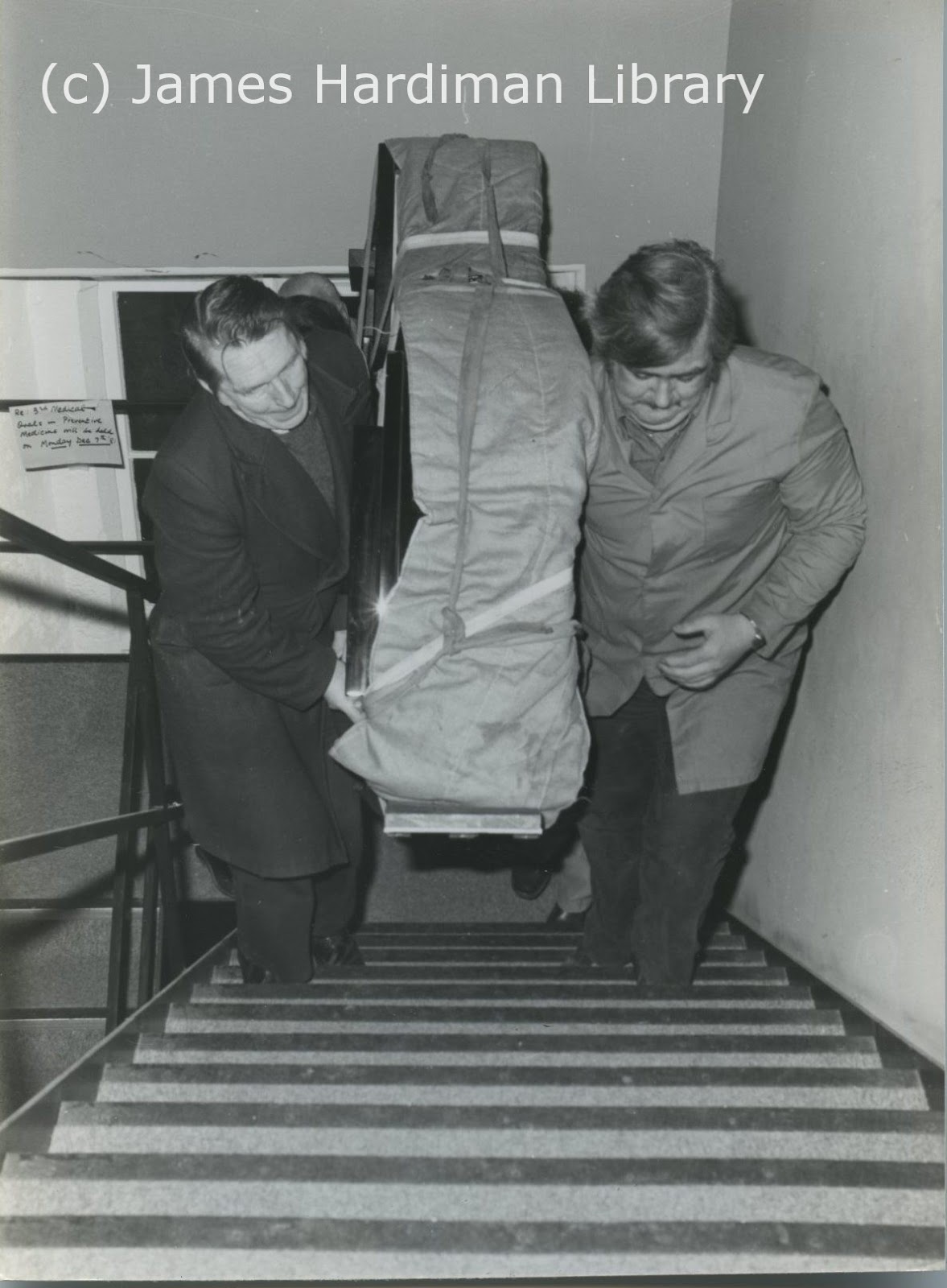
The archive ranges in date from
1981 to 2011 and includes numerous series of original records documenting the
Irish and international acts that played to audiences across Galway and the
West of Ireland. The archive traces the relationship between Music for Galway
and National University of Ireland, Galway, as the group found a home for
concerts and their grand piano at the Aula Maxima on the University's campus.
The archive consists of nineteen
boxes of records comprising of a comprehensive record of Music for Galway's
legacy. The archive includes records of productions including posters, flyers,
invitations, programs and press releases; numerous black and white and also
colour photographs of Music for Galway committee members and also of musicians
and concerts, financial records, details of membership and rates,
correspondence between Music for Galway and various musicians and groups, Music
for Galway Newsletters and press cuttings of news and coverage of concerts and
events.
The archive will be launched by
Erika Casey, founding member of Music for Galway and the evening will include
an exhibition of material from the archive, an overview of the archive material
and a performance from Con Tempo Quartet. A reception will follow this
performance. The event will take place at the Aula Maxima, NUI Galway, 19th
November, 6pm.
Subscribe to:
Posts (Atom)
