Tuesday, July 21, 2020

The Galway International Arts Festival - An Archive of Stories and Spectacle


Mid-summer in Galway has become synonymous with one thing. For forty years the Galway International Arts Festival has grown to become not just the highlight of Galway's cultural and artistic calendar but also to be one of the largest cultural celebrations in Europe. 

The archive of the Galway International Arts Festival resides within the Hardiman Library of NUI Galway. The GIAF archive is a detailed record of the history and achievements of the festival, as well as an account of its establishment and its growth over many years. It offers a record of how GIAF engaged not just the best of Irish artists and performers of all kinds, but also brought leading international artists to Galway each year. The archive consists of over thirty-five boxes of manuscripts and documents, comprising some of the first minute books of the Festival committee, correspondence with leading artists, programmes and posters for various events, an expansive photographic collection, press cuttings, and of course the famous Galway Arts Festival posters.


The archive includes a detailed record of administration, productions, and events held during the Galway International Arts Festival since its inception in 1978. Within the administrative records, there are editions of minutes from Galway Arts Festival committee and management meetings 1980-1982. The production files include a large volume of photographs from productions and events across all disciplines in the Galway Arts Festival. The photographs document events across theatre, comedy, dance, music, literature, visual art, street performance, and children's events. The images are also a record of the audiences and experiences of GIAF - those who each year return, witness, enjoy and take part in a celebration of the arts in Galway and which ripples outward into the world. 


The archive also includes a large volume of artist and event posters and other promotional ephemeral material. The series of press files contain records of local (Galway and west of Ireland) press cuttings of interviews and features with artists, members of Galway Arts Festival directors and management, reviews of productions and events at the festival and news on arts, theatre and culture in general nationwide around Ireland. The press files also offer a detailed and comprehensive list of events in various codes including theatre, music, visual art, children's events, literature provide an account of all acts which performed each year at the festival. Hearing the stories of visiting artists as well as local and Irish artists gives an indication of what it meant for a practitioner to have their work as part of the GIAF as well as collecting the many voices and stories of those who make the festival programme a special experience each year.


The records show how the people of Galway, the west of Ireland and from much further afield have been an active part of the spectacle of the festival. Images of crowded streets and venues across the city show how audiences have been enthralled by all the Festival has to offer for all tastes and interests. The archive also compliments other related local artistic and cultural archives, such as those of Druid Theatre Company, Taibhdhearc na Gaillimhe, Macnas and many others, building a comprehensive memory of the Arts in Galway for over the past four decades.


A full listing of the Galway Arts Festival archive is available on the Archives online catalogue

For any visitors to the Galway International Arts Festival and are curious about this amazing archive collection, please contact the Archives service for information on access.


Wednesday, July 15, 2020

A (Staycation) Travel Miscellany - Sources for History of Travel in Ireland


As we are allowed to expand our horizons to travel anywhere in Ireland from 29 June, it is worth looking back at some of the tourist accounts and travel guides relating to Ireland published during the twentieth century. The first half of the century witnessed the zenith of the Irish railway network when the whole island was connected by rail. In 1906 a map was published to accompany the report of the Vice-regal Commission on Railways in Ireland. It is contained in the Commission’s full report which is available through the House of Commons Parliamentary papers database on the library website or the Enhanced Parliamentary Papers Ireland website at http://www.dippam.ac.uk/eppi. You can also access the map on Wikimedia Commons at https://commons.wikimedia.org/wiki/File:Map_Rail_Ireland_Viceregal_Commission_1906.jpg.

The Midland and Great Western Railway Company’s branch line to Clifden ran through our university campus. When you walk from the library towards Distillery road, you are walking on the railway! If you would like to read some of the guides to excursions on this and other West of Ireland lines you can do so at http://mgwr.weebly.com/downloads.html. We have the original edition of the Midland & Great Western’s detailed handbook from 1900, Ireland from Sea to Sea but sadly that’s not yet available digitally.


While lots of travel guides for 19th century Ireland have been digitised and made available online, fewer volumes from the 20th century are on offer yet, mostly because quite a lot of the material is still subject to copyright. You will have to wait for the reopening of the Archives and Special Collections Room, hopefully in the next few months, in order to read these volumes for yourself but here are a few illustrations from them to whet your appetite!

O’Neill Lane, T. Round Erin or Highways and byways in Ireland (Abbeyfeale, County Limerick: [the author], c.1900).
Irish Tourist Authority. Ireland: Official Guide (Dublin, c.1946),
Bord Fáilte. Illustrated Ireland guide. (Dublin, 1968),
Newby, Eric & Petry, Diana. Wonders of Ireland: a personal choice of 484 (London: Hodder & Stoughton, 1969)


In the meantime, though, you might like to try Thomas O’Neill Russell. The beauties and antiquities of Ireland (1897), and Dorling Kindersley’s Eyewitness Guide to Ireland (2012), the full text of which is available through the library catalogue. If you would like to read more about Irish travel writing the journal Studies in Travel Writing devoted a special issue to the subject in 2016 (Volume 20, Issue 2) which can also be accessed via the library catalogue. Enjoy your trips and stay safe!

Swords Round Tower


Monday, July 13, 2020

Remembering 'Big Jack'

The recent passing of the former Irish football team manager, Jack Charlton, has prompted an outpouring of memories and tributes from many who fondly remember 'Big Jack'. 
In the archive of the Galway International Arts Festival is this press cutting from the Galway City Tribune with an image of a sculpture of none other than Jack Charlton. The sculpture was made from discarded oil drums by Galway city motor mechanics Gay and Patsy Farrell. It was placed outside the Kenny Art Gallery, then located in Middle Abbey Street during the Heroes and Heroines exhibition in conjunction with the 1994 Galway Arts Festival. Ireland was in the grip of World Cup fever in the summer of 1994, as well as Arts Festival fever at this time, so it is no wonder ‘Big Jack’ made an appearance on the streets of Galway that summer. 

Monday, June 8, 2020

Public Health in Galway 150 years ago - new online source


Some of the excellent Galway history sources digitized by Galway County Archives have now been indexed by the family history website 'findmypast.ie' to which the Hardiman Library has a subscription. These resources include some surviving Galway Poor Law Union and Galway County burial records. While these have been available in pdf format on the County Archives website for some time they have now been indexed and transcribed by Find My Past, meaning it is easier to search for individual names of people and places within the documents. 

Much of the Poor Law Union records are the minutes of Board of Guardians meetings. These provide an insight into how public health was managed as well as the provision of relief to the poor in 19th century County Galway.  Geographical areas covered in the Poor Law Union or Workhouse area records include Clifden, Glenamaddy, Gort, Mountbellew, Portumna and Tuam.

Find My Past can be accessed by signing in to the library catalogue with your NUI, Galway log in. 

PDFs of the documents can also be viewed on the Galway County Archives website at http://www.galway.ie/en/services/more/archives/digital/.


The illustration shows plans for the Galway County Infirmary building and a ticket permitting the patient named to attend the Dispensary doctor for medical advice and treatment.in 1884. 

Wednesday, May 13, 2020

Podcast - John McGahern: The Writer and the Archive

John McGahern
John McGahern said of the world of the writer and of the reader "I think each of us inhabit a private world that others cannot see" – the archive brings those two private worlds together and is perhaps the only place this can happen.

There are close to forty boxes of manuscripts in the McGahern archive and with many more related collections at the Hardiman Library of NUI Galway, the literary and personal papers of John McGahern are a pathway through the writing of one of Ireland’s most celebrated of modern Irish writers. This podcast explores the archive of McGahern, its many drafts, letters and insights into the life and work of John McGahern.


Manuscripts of  'Bank Holiday', McGahern Archive, Hardiman Library

Wednesday, April 22, 2020

Podcast - Kevin Boyle: The Archive and Human Rights

Professor Kevin Boyle
An activist, a scholar and a leading human rights advocate, Kevin Boyle has left a legacy of impacts and memories working on behalf of others both in Ireland and internationally. Boyle is a figure who witnessed and was part of the growth and direction of the Civil Rights movement in Northern Ireland in the 1960s; was instrumental in the development of the Law Faculty and Human Rights Centres at NUI Galway and later at University of Essex; as well as leading major international NGOs, and later working alongside Mary Robinson at the United Nations in 2001. Boyle's archive of over 120 boxes of manuscripts includes letters, records of legal cases, academic research, notebooks, as well as ephemera from major international political and social events around the world.


Available at the Hardiman Library, NUI Galway, the Boyle archive is an insight into the life and career of activist scholar, Kevin Boyle. This podcast is an overview and introduction to the archive of Kevin Boyle and of the documentation of a career and life spent working in law and human rights, from Northern Ireland in the 1960s to the United Nations in the post 9/11 world.

You can listen to the podcast below and also search the catalogue of the Boyle archive online here.


Civil Rights March, Northern Ireland [January 1969] Kevin Boyle Archive, NUI Galway

Friday, April 17, 2020

Cartlann Chonradh na Gaeilge - Taispeántas Digiteach Seolta


An mhí seo caite seoladh miontaispeántas digiteach de Chartlann Chonradh na Gaeilge, ina raibh níos mó ná 40 íomhá ón mbailiúchán ar taispeáint, mar chuid d’imeachtaí Sheachtain na Gaeilge. Maith mar a tharla, bhí an obair ionann is críochnaithe sular tugadh ordú dianghlasála de bharr COVID-19, agus bhíomar in ann an taispeántas iontach seo a sheoladh go cianda Lá Fhéile Pádraig, lá deiridh an fheachtais bhliantúil. I mblaganna roimhe seo (féach na naisc thíos) rinne mé cur síos ar an obair a bhíonn ar bun sa chúlra sula gcuirtear bailiúchán ar fáil don phobal, ar na cúraimí a chaithfidh cartlannaí a chur i gcrích agus ar na cinntí a chaithfear a ghlacadh. Fógraíodh freisin go gcuirfí ábhar ar fáil don phobal diaidh ar ndiaidh, in ionad fanacht go mbeadh an bailiúchán uile próiseáilte go hiomlán, de bharr ollmhéid an bhailiúcháin iontaigh seo. Mar sin de, dearadh an taispeántas nua seo le feidhm an-tábhachtach eile a chur i gcrích - tugann sé comhthéacs don úsáideoir, rud a bhfuil tábhacht nach beag leis nuair atá rochtain á soláthar de réir a chéile ar an mbonn seo.


Comhthéacs:

Nuair atá ábhar ó bhailiúchán cartlainne á scrúdú, tá sé ríthábhachtach go dtuigeann an t-úsáideoir comhthéacs an ábhair sin. Mar shampla: Cén chaoi a mbaineann an t-ábhar seo leis an mbailiúchán trí chéile? Cén chaoi a mbaineann sé le hábhair eile sa bhailiúchán? Cuidíonn an taispeántas seo leis an úsáideoir teacht ar fhreagraí na gceisteanna sin. Ar an gcéad dul síos, ar an leathanach baile tugtar eolas cúlra faoin eagraíocht féin, faoin tréimhse ama a gclúdaítear sa bhailiúchán, faoin dóigh agus faoin tráth ar bailíodh an t-ábhar seo agus ar tugadh do OÉG é.


Ar an dara leathanach den taispeántas ar líne ("Leagan amach"), tugtar mioneolas ar an dóigh a leagtar an bailiúchán amach, ar an gcúis ar grúpáladh ábhair áirithe le chéile, agus ar an gcúis ar glacadh cinntí áirithe. Nuair atá leagan amach bailiúcháin á shocrú, bíonn an cartlannaí i gcónaí ag smaoineamh ar cé chomh hinaimsithe a bheidh ábhar an bhailiúcháin agus cé chomh furasta agus a bheidh sé ag úsáideoir an bailiúchán a leanúint. (Déantar cur síos ar chuid den phróiseas cinnteoireachta sin anseo).


Ar deireadh ar an leathanach “Na sraitheanna”, tá 45 íomhá le feiceáil, tagraíonn gach íomhá do shraith ar leith, agus tá cur síos ar an tsraith chéanna ceangailte le gach íomhá. Faoi láthair tá 13 shraith ar oscailt don phobal, mar a luadh cheana, agus sna cásanna seo tá naisc chuig catalóg na cartlainne le fáil sa chur síos. Tá an-tairbhe ag baint le bheith in ann cur síos ar gach aon cheann de na 45 sraith a fheiceáil (ní hamháin na cinn atá inrochtana), agus ciallaíonn sé go dtuigeann an t-úsáideoir an comhthéacs lena mbaineann an t-ábhar atá curtha ar fáil, agus eolas aige/aice ar céard le bheith ag súil leis ó ábhair a chuirfear ar fáil amach anseo.


An chaoi leis an Taispeántas Digiteach a leanúint:

Fiú má thugann an t-úsáideoir sracfhéachaint bheag ar an taispeántas seo, ar a laghad, gheobhaidh sé/sí léargas ar obair Chonradh na Gaeilge mar eagraíocht agus ar an ábhar a tugadh do OÉG. Is pléisiúr ann féin é dul trí na 45 íomhá atá ar fáil ar an leathanach “Na sraitheanna”. Le tairbhe cheart a bhaint as an taispeántas seo, áfach, moltar don úsáideoir tuiscint cheart a fháil ar an dóigh chun an chatalóg chartlainne a leanúint. Is trí thástáil agus trí earráid a dhéanamh is fearr a gheofar an t-eolas seo, ach tá iarracht mhór déanta agamsa anseo le cur síos a dhéanamh ar an bpróiseas féin.

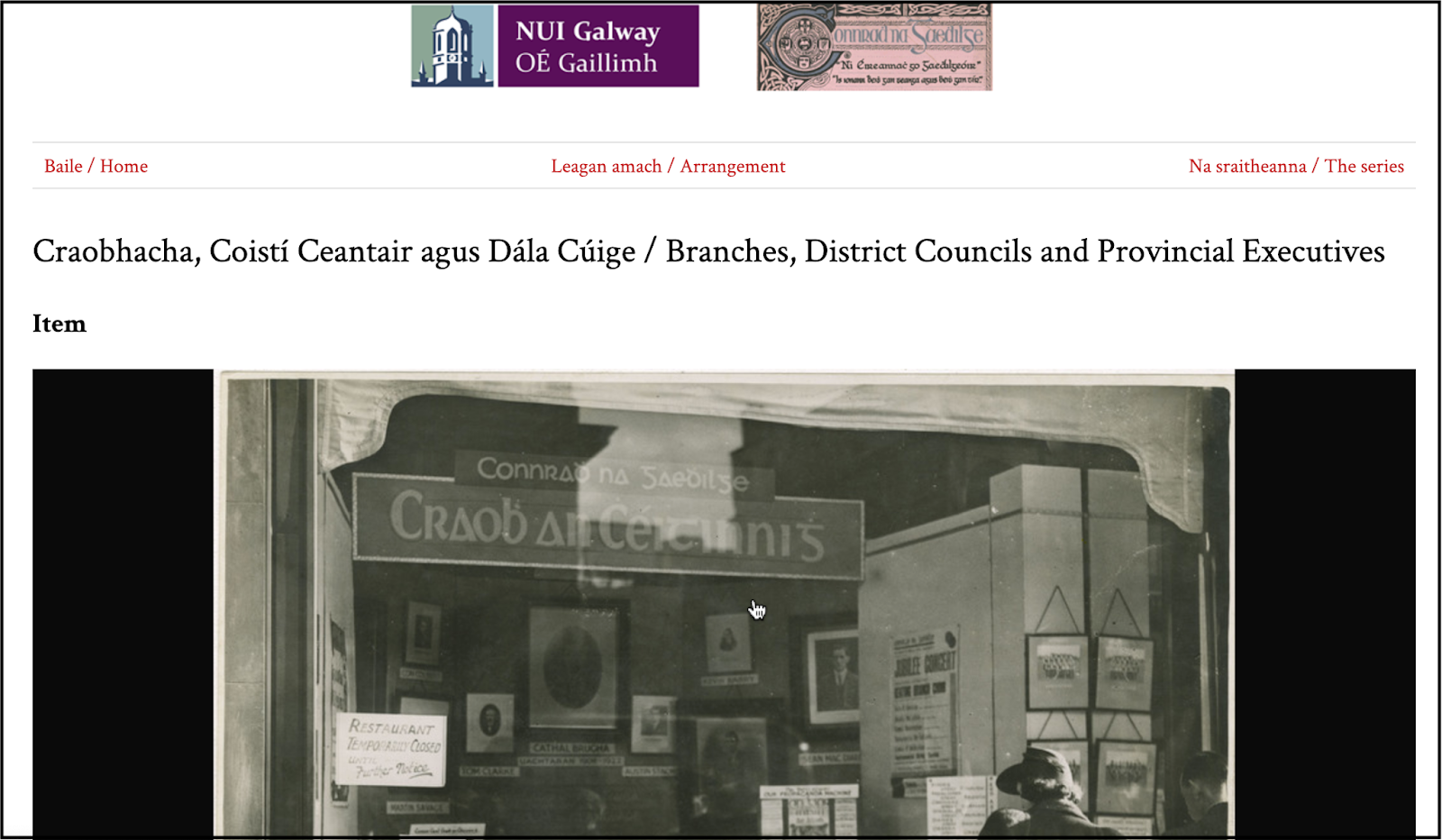
Nuair a chliceálann úsáideoir ar cheann ar bith de na 45 íomhá a bhaineann le sraitheanna aonair, tugtar chuig bosca dialóige iad ina bhfuil leagan níos mó den íomhá ar chlé, agus cur síos dátheangach ar an tsraith féin ar dheis.


Faoi bhun an téacs sin tá deilbhín beag den íomhá chéanna le feiceáil, agus nasc taobh leis nó faoina bhun (féach íomhá). Más mór agus más fada an téacs, seans go mbeidh ort scrollú síos leis na deilbhíní seo a aimsiú.


Trí chliceáil ar an deilbhín nó ar an nasc osclaítear leathanach nua mar a dtugtar ní hamháin an cur síos, ach meiteashonraí eile amhail eolas faoin bhfoilsitheoir, teideal na sraithe, aitheantóir uathúil agus, i gcás gur cuireadh an tsraith ar fáil don phobal, nasc chuig catalóg na cartlainne (is féidir teacht air seo sa réimse “relation”). (Arís eile, beidh ort scrollú síos an leathanach le teacht ar an eolas uile seo.)


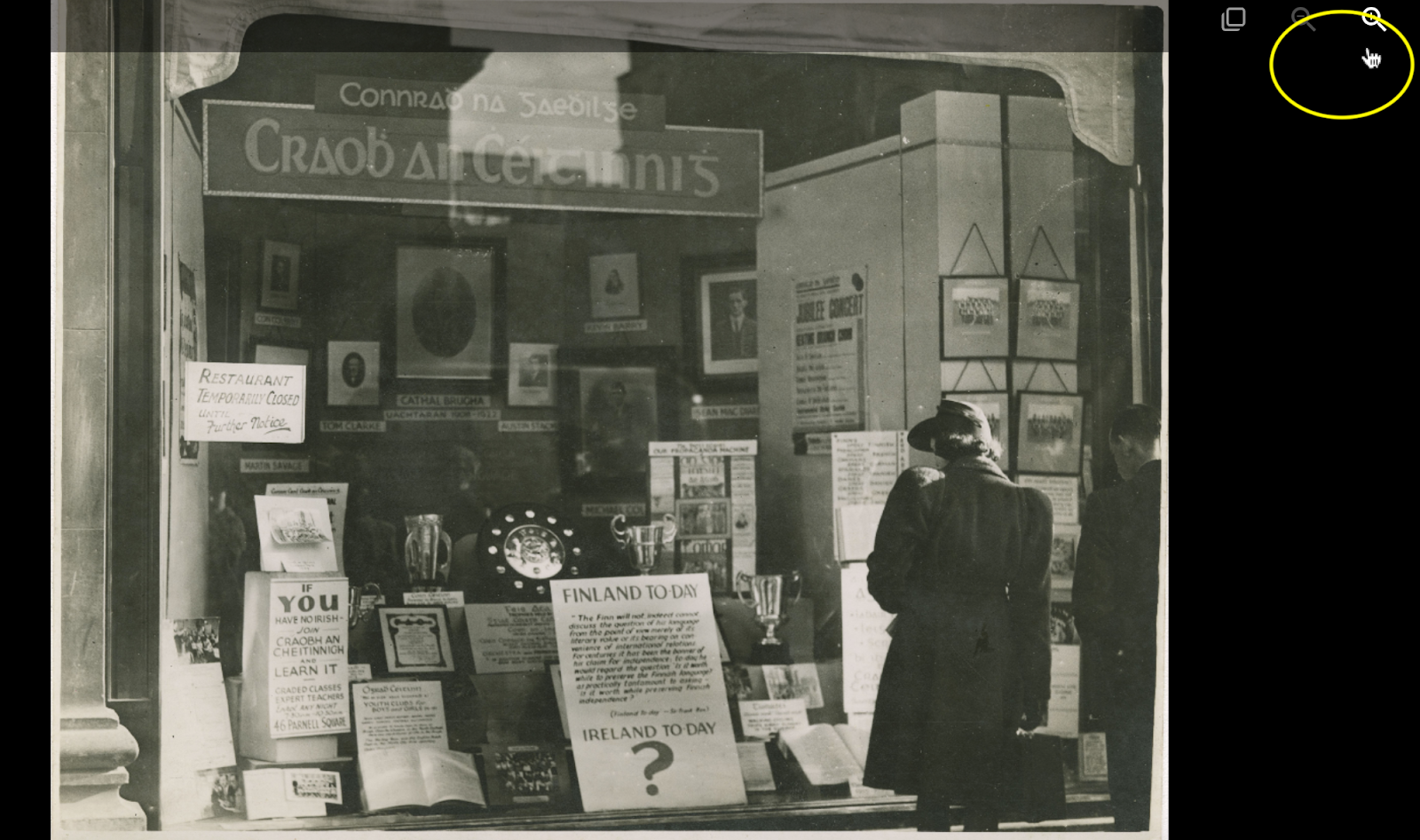
Tugtar leagan níos mó den íomhá freisin agus is féidir tuilleadh scrúdú a dhéanamh air sin trí zúmáil isteach.


An chaoi le Catalóg na Cartlainne a úsáid:

CALM a thugtar ar an mbunachar cartlainne a mbaintear úsáid as in OÉG agus is anseo atá gach ábhar atá catalógaithe inár gcartlanna le fáil. Nuair a dhéanann úsáideoir cliceáil ar aon cheann de na naisc ar an leathanach “sraitheanna” de chuid thaispeántas digiteach Chonradh na Gaeilge, ní hamháin go dtugtar chuig an mbunachar cartlainne é/í, ach tugtar chuig suíomh ar leith é/í freisin – an iontráil chatalóige don tsraith sin.


Taispeánfar arís an cur síos mar aon le haon eolas nua amhail an raon dátaí, an fhormáid (e.g. páipéar, grianghraif, comhad fuaime) agus an líon (cé mhéad bosca, foshraith, comhad etc.). Mar sin féin, is dócha gurb é an nasc chuig an mbrabhsálaí ordlathais an uirlis is úsáidí atá ar fáil ar an leathanach seo, nasc atá le fáil sa réimse “Ref No”. (San íomhá thíos, tá an cúrsóir ar an nasc seo).


Céard é an Brabhsálaí Ordlathais?

Is é seo ordlathas aon bhailiúcháin agus taispeánann sé sraitheanna, foshraitheanna, comhaid agus ábhar de réir ordlathais ar geall le crann é in ord íslitheach. Sa sampla thuas tá an iontráil chatalóige don 4ú sraith sa bhailiúchán “Craobhacha...” le feiceáil. Trí chliceáil ar an nasc G60/4 sa réimse “Ref No”, tugtar chuig an mbrabhsálaí ordlathais muid, agus ní hamháin go bhfeicfimid mar a bhaineann an tsraith seo le comhthéacs an bhailiúcháin iomláin (tá sé aibhsithe i gcló buí), ach feicfimid freisin na foshraitheanna agus na comhaid atá sa tsraith ar leith seo.


Taispeánann na deilbhíní + agus – ar thaobh clé na sraithe, na foshraithe etc. gur féidir a thuilleadh fairsingithe a dhéanamh [féach na híomhánna].


Is dóigh gurb é an brabhsálaí ordlathais an bealach is fusa leis an mbailiúchán catalógaithe a leanúint. De réir mar a chuirtear tuilleadh tráinsí ar fáil, is amhlaidh a chuirfear na hiontrálacha catalóige a bhaineann leo le bunachar na cartlainne. Cuirfear naisc ón taispeántas digiteach leis seo freisin d’fhonn aird a tharraingt ar na hiontrálacha nua seo.

Mar sin de, ní hamháin gur taispeántas oideachasúil spraíúil é an taispeántas seo as féin, ach is uirlis thábhachtach é freisin le comhthéacs an ábhair agus na sraitheanna i mbailiúchán Chonradh na Gaeilge a thuiscint AGUS mar nasc áisiúil le rochtain a fháil agus cuardach a dhéanamh ar chatalóg chartlainne CALM. De réir mar a dhéantar dul chun cinn ar phróiseáil agus ar chatalógú an bhailiúcháin, is amhlaidh atá an taispeántas seo ina fhráma foirfe tagartha leis na sraitheanna is déanaí a chuardach de réir mar chuirtear ar fáil iad.

Más é go bhfuil an taispeántas á fheiceáil agat den chéad uair, nó más é go bhfuil tú ag seiceáil le fáil amach ar cuireadh sraitheanna ar leith ar fáil, tá súil agam go mbainfidh tú taitneamh as!


Go dtí an chéad uair eile,

Beir bua,

Niamh


English version:


Naisc eile: